HomeDiagramsDatabaseMapsForum About
     

Go Back   SkyscraperPage Forum > Discussion Forums > City Discussions


Reply

 
Thread Tools Display Modes
     
     
  #1041  
Old Posted Yesterday, 1:02 PM
Crawford Crawford is offline
Registered User
 
Join Date: Nov 2003
Location: Brooklyn, NYC/Polanco, DF
Posts: 34,758
Core Columbus also includes prosperous large neighborhoods like German Village. I don't think Indy has in-town equivalents.
Reply With Quote
     
     
  #1042  
Old Posted Yesterday, 2:30 PM
ColDayMan's Avatar
ColDayMan ColDayMan is offline
B!tchslapping Since 1998
 
Join Date: Jul 2001
Location: Columbus
Posts: 20,474
Quote:
Originally Posted by Steely Dan View Post
With all due respect, I don't think that I am.

Yes, old city Columbus was falling (just like the vast majority of all US urban cores at the time), but it didn't fall as far as the other two during the urban dark ages.

Why?

Let's disregard the past 26 years for a moment:


"Old City" Columbus (40 sq. miles):

1950: 375,710

2000: 246,713

Change: -34.3%


Center Township, Indianapolis (42 sq. miles):

1950: 337,211

2000: 167,055

Change: -50.5%


That's 16 points of difference! All cities at the time experienced precipitous drops in average household size, somewhere in the neighborhood of -25% to -33%, so the numbers above would indicate that center township Indy lost far more actual households than old city Columbus did over those 5 decades. 21st century urban infill can't account for that.
I mean, falling 35% or 50% is still, ya know, not good. They still all fell together, some clearly a little faster than others, but the general point was that Columbus wasn't exactly holding it together during that timeframe versus Indy/KC at -35%. It just had more stable neighborhoods (as Crawford implied), much assuming like Milwaukee was during that time.
__________________
Click the x: _ _ X _ _!
Reply With Quote
     
     
  #1043  
Old Posted Yesterday, 2:48 PM
mrnyc mrnyc is offline
cle/west village/shaolin
 
Join Date: Jul 2006
Posts: 15,234
it cannot be understated that vs other places the stability of the university and state capital work floated columbus over the bad old days for cities and the rustbelt.

that said, i agree it most certainly fell off hard just like everywhere else did.

and today it is most definitely focused on quiet infill vs doing downtown skyscrapers like its texan cousin austin, but those too will come along eventually.
Reply With Quote
     
     
  #1044  
Old Posted Yesterday, 2:50 PM
eschaton eschaton is online now
Registered User
 
Join Date: Dec 2013
Posts: 5,594
Eyeballing the immediate downtown areas on the map:

Highways: Columbus is worse than Indy. Downtown Columbus is completely surrounded by a ring of highways. In contrast, Indianapolis is only surrounded on three sides, with direct access to the west to neighborhoods across the White River.

White Flight: Columbus again is actually a bit worse, as there are black neighborhoods immediately to the Northeast and Southeast of Downtown. Indy's black areas start a bit further out from the core. It should be noted that the immediate black neighborhoods close to the core in both cities don't show much in the way of blight, however - Maybe 10% to 20% vacant lots, but not Rust Belt style urban prairie.

Residential development within core: Indy looks a bit better here again. There's big non-residential zones (like around the stadiums) but the historic residential neighborhoods of Fletcher Place and Lockerbie Square remain intact, with heavy infill in areas like Renaissance Place. In contrast, outside of a few blocks, Downtown Columbus really lacks a residential fabric. Downtown Indy has about 22,000 people as well, while Downtown Columbus has about 10,000.

I guess the conclusion I draw from all of this is it seems whatever has helped Columbus is outside the immediate core zone around Downtown. The Ohio State University undoubtedly helped. Even if there wasn't a ton of new development, rising student enrollment does help to cancel out the impact of falling household size - particularly when a half dozen college kids are renting a house together.
Reply With Quote
     
     
  #1045  
Old Posted Yesterday, 2:57 PM
mrnyc mrnyc is offline
cle/west village/shaolin
 
Join Date: Jul 2006
Posts: 15,234
Quote:
Originally Posted by eschaton View Post
Eyeballing the immediate downtown areas on the map:

Highways: Columbus is worse than Indy. Downtown Columbus is completely surrounded by a ring of highways. In contrast, Indianapolis is only surrounded on three sides, with direct access to the west to neighborhoods across the White River.

White Flight: Columbus again is actually a bit worse, as there are black neighborhoods immediately to the Northeast and Southeast of Downtown. Indy's black areas start a bit further out from the core. It should be noted that the immediate black neighborhoods close to the core in both cities don't show much in the way of blight, however - Maybe 10% to 20% vacant lots, but not Rust Belt style urban prairie.

Residential development within core: Indy looks a bit better here again. There's big non-residential zones (like around the stadiums) but the historic residential neighborhoods of Fletcher Place and Lockerbie Square remain intact, with heavy infill in areas like Renaissance Place. In contrast, outside of a few blocks, Downtown Columbus really lacks a residential fabric. Downtown Indy has about 22,000 people as well, while Downtown Columbus has about 10,000.

I guess the conclusion I draw from all of this is it seems whatever has helped Columbus is outside the immediate core zone around Downtown. The Ohio State University undoubtedly helped. Even if there wasn't a ton of new development, rising student enrollment does help to cancel out the impact of falling household size - particularly when a half dozen college kids are renting a house together.
it's true direct downtown developments have always lagged in columbus, a giantazz mall taking up the middle of downtown was a problem for a long time, i always hated that good riddance, but it's kind of purposeful and in the meantime they are doing everything else to make downtown better.

so the table is set.

i have long had the belief columbus is one of those places where downtown towers and transit will explode all at once.
Reply With Quote
     
     
  #1046  
Old Posted Yesterday, 3:00 PM
3rd&Brown 3rd&Brown is offline
Registered User
 
Join Date: Oct 2007
Posts: 3,015
Quote:
Originally Posted by eschaton View Post
Eyeballing the immediate downtown areas on the map:

Highways: Columbus is worse than Indy. Downtown Columbus is completely surrounded by a ring of highways. In contrast, Indianapolis is only surrounded on three sides, with direct access to the west to neighborhoods across the White River.

White Flight: Columbus again is actually a bit worse, as there are black neighborhoods immediately to the Northeast and Southeast of Downtown. Indy's black areas start a bit further out from the core. It should be noted that the immediate black neighborhoods close to the core in both cities don't show much in the way of blight, however - Maybe 10% to 20% vacant lots, but not Rust Belt style urban prairie.

Residential development within core: Indy looks a bit better here again. There's big non-residential zones (like around the stadiums) but the historic residential neighborhoods of Fletcher Place and Lockerbie Square remain intact, with heavy infill in areas like Renaissance Place. In contrast, outside of a few blocks, Downtown Columbus really lacks a residential fabric. Downtown Indy has about 22,000 people as well, while Downtown Columbus has about 10,000.
Casual observer here with no skin in the game. But as someone who goes to both Indianapolis and Columbus for work occasionally, I find downtown Columbus to be FAR more lively than downtown Indy. Granted, I might not be thinking specifically of downtown because I don't know the exact definitions, but there's definitely more pedestrian activity in Columbus than in Indy. It could also be that there are just denser close in neighborhoods in Columbus like German Village and the Short North that sort of blend seemlessly with downtown and really I'm characterizing those, but I dont' remember seeing any close in heavily residential neighborhoods in Indy that felt connected and super walkable.
Reply With Quote
     
     
  #1047  
Old Posted Yesterday, 3:09 PM
eschaton eschaton is online now
Registered User
 
Join Date: Dec 2013
Posts: 5,594
Quote:
Originally Posted by 3rd&Brown View Post
Casual observer here with no skin in the game. But as someone who goes to both Indianapolis and Columbus for work occasionally, I find downtown Columbus to be FAR more lively than downtown Indy. Granted, I might not be thinking specifically of downtown because I don't know the exact definitions, but there's definitely more pedestrian activity in Columbus than in Indy. It could also be that there are just denser close in neighborhoods in Columbus like German Village and the Short North that sort of blend seemlessly with downtown and really I'm characterizing those, but I dont' remember seeing any close in heavily residential neighborhoods in Indy that felt connected and super walkable.
I do think it's true that outside of the immediate area around the highway loop, Indy lacks a real urban fabric. Fountain Square has a bit going on, I guess, which is immediately adjacent to the Downtown highway loop (Similar to German Village/Short North). there's a lot of activity in Broad Ripple too, though it's sort of this weird isolated node surrounded by semi-suburban density.
Reply With Quote
     
     
  #1048  
Old Posted Yesterday, 4:55 PM
Velvet_Highground Velvet_Highground is offline
Doc Love 3.0
 
Join Date: Mar 2022
Location: Metropolitan Detroit
Posts: 705
Columbus really rolled a great hand when playing the rust belt game. Capital city which is at the very least business and adds to the tax base having one of the largest and most prestigious universities though helped by having a large generally well off student body that needs housing. Forward thinking coming from the institution on how to make a strong impact as well as wanting projects that live up to the high standard the university represents.

Madison and Ann Arbor & Lansing are all nice cities with Lansing being a bit different due to the Lansing / East Lansing divide. You have University of Wisconsin in Milwaukee and Michigan and or Michigan State in Detroit the city’s would be very different places Detroit would most likely have at least an average mass transit system. The ability to annex during the really aggressive suburban expansion post riot phase was a lifeline for holding back the negative feedback loop of post industrial decay.

There’s a lot of other factors that get talked about like geography, climate, coast & or waterfront, good transit & ability to expand. While other people might argue about the Chicago effect it’s the reason why constraints were placed on Detroit’s ability to grow by turning annexation into an electoral issue. There does seem to be an inherent fairness to it at face value people chose to live where they are what mechanism should allow that to change is fair.

Even if it was designed to specifically kneecap Detroit’s growth. It’s an interesting philosophical question where that line of for the good of the people actually is or where it should be. No one wants to wake up one day and have for the public good destroying a community for a cause they don’t believe in and have no recourse. Although perhaps if racial tensions were less and the system was a more just and fair one we wouldn’t be having this debate.

Although I personally think the more you look into the rust belt, Appalachia, the delta & or the Res you find yourself getting into really good meat and potato level debates on what the bleeding edge of America as a system, polity & social experiment looks like for good and ill. There’s other perspectives from different angles are apt too. But I think a lot can be learned from stress test and deindustrialization has been the great societal challenge of the past 60 years.

But like what worked what’s replicable, what’s unique to circumstance and or location. It’s really interesting to me at least. Arguably race is just as or in many cases more important redlining and the issue of integration of schools can’t be downplayed.

Edit* I think it goes without saying but it’s always worth mentioning considering the subject at hand. The Great Migration might almost be too on the nose but this is American English that’s how we roll.
__________________
The border between democracy and authoritarianism is the least protected border in the world. - Ivan Krastev
Reply With Quote
     
     
  #1049  
Old Posted Yesterday, 5:35 PM
Crawford Crawford is offline
Registered User
 
Join Date: Nov 2003
Location: Brooklyn, NYC/Polanco, DF
Posts: 34,758
IMO Downtown Columbus is terrible, one of the worst pound-for-pound in the Midwest. Definitely worse than Indy. But everything surrounding downtown is far, far more vibrant and cohesive than Indy, and Columbus just feels more urban and lived-in, with tons of infill. Also feels more progressive, educated and affluent.

I hate to bring up a mall, but Easton Town Center essentially serves as a CBD, and is walkable, lively and quasi-urban. I'd rather stay at Easton than downtown, and I'm an urbanist. At Easton I've walked to a nice dinner and bookstore. Can't do that downtown.
Reply With Quote
     
     
  #1050  
Old Posted Yesterday, 5:50 PM
Steely Dan's Avatar
Steely Dan Steely Dan is online now
devout Pizzatarian
 
Join Date: Jul 2001
Location: Lincoln Square, Chicago
Posts: 30,257
Quote:
Originally Posted by ColDayMan View Post
I mean, falling 35% or 50% is still, ya know, not good.
But that was the very divergence I noted that started this whole discussion.

You then tried to argue that it was simple: "infill".

I then showed that 21st century urban infill had nothing to do with center township Indy falling significantly further than old city Columbus during the urban dark ages.

And your response appears to be "who cares, matters of degree don't matter anyway".


Excuse me for thinking that they do. Especially when we account for the fact that ~25% of the population decline in any urban center over the last 5 decades of the 20th century was due to the decrease in average household size across the entire nation over that time period. Taking that 25% out of their population declines as an external given, it becomes apparent that center township Indy lost a lot more actual households than old city Columbus did. Ditto for old city KC vs. old city Milwaukee.

Yes, they ALL declined, but clearly not at the same rates.

I find exploring the reasons behind those kinds of differences fascinating.


Quote:
Originally Posted by eschaton View Post
Downtown Indy has about 22,000 people as well, while Downtown Columbus has about 10,000.
how are you defining "downtown" here?

looking at 2020 tract maps I get:

downtown Indy - 5 tracts - 19,189 people - 3.9 sq. miles - 4,920 ppsm

downtown Columbus - 3 tracts - 9,687 people - 2.2 sq. miles - 4,403 ppsm


not really an earth-shattering density difference there.


Quote:
Originally Posted by eschaton View Post
there's a lot of activity in Broad Ripple too, though it's sort of this weird isolated node surrounded by semi-suburban density.
Important to note here that Broad Ripple is 3 miles outside of center township Indy.


Quote:
Originally Posted by Velvet_Highground View Post
While other people might argue about the Chicago effect it’s the reason why constraints were placed on Detroit’s ability to grow by turning annexation into an electoral issue.
what "Chicago effect" are you speaking of?
__________________
"Missing middle" housing can be a marvelous middle ground for many middle class families.

Last edited by Steely Dan; Yesterday at 7:06 PM.
Reply With Quote
     
     
  #1051  
Old Posted Yesterday, 6:03 PM
eschaton eschaton is online now
Registered User
 
Join Date: Dec 2013
Posts: 5,594
Quote:
Originally Posted by Steely Dan View Post
how are you defining downtown here?
Went into Dave's Redistricting App, and drew a fake district for every block within the central highway loop/on the downtown side of rivers. Seems like the best possible definition of a "continuous greater downtown."

Quote:
Originally Posted by Steely Dan View Post
Important to note here that Broad Ripple is 3 miles outside of center township Indy.
True. Walkable nodes outside downtown are few/far between in Indy, though.

Columbus is no great shakes, but there's a walkable core that runs roughly from German Village to Old North Columbus, with a bit not far away in Grandview Heights as well.

Last edited by eschaton; Yesterday at 6:17 PM.
Reply With Quote
     
     
  #1052  
Old Posted Yesterday, 6:06 PM
iheartthed iheartthed is offline
Registered User
 
Join Date: Oct 2009
Location: New York
Posts: 11,894
Quote:
Originally Posted by Velvet_Highground View Post
Madison and Ann Arbor & Lansing are all nice cities with Lansing being a bit different due to the Lansing / East Lansing divide. You have University of Wisconsin in Milwaukee and Michigan and or Michigan State in Detroit the city’s would be very different places Detroit would most likely have at least an average mass transit system. The ability to annex during the really aggressive suburban expansion post riot phase was a lifeline for holding back the negative feedback loop of post industrial decay.
Never been to Madison but Ann Arbor is a much, much, much better looking city than Lansing. Lansing is a pretty ugly city and is evidence to me that the neglect of Michigan cities has always been a statewide issue, not just a Detroit (or Flint, or Saginaw, or Muskegon, or Pontiac, or...) problem. Ann Arbor and maybe Grand Rapids are basically the exceptions to the rule in Michigan.
Reply With Quote
     
     
  #1053  
Old Posted Yesterday, 7:42 PM
The North One's Avatar
The North One The North One is offline
Registered User
 
Join Date: Sep 2009
Posts: 5,889
Quote:
Originally Posted by iheartthed View Post
Never been to Madison but Ann Arbor is a much, much, much better looking city than Lansing. Lansing is a pretty ugly city and is evidence to me that the neglect of Michigan cities has always been a statewide issue, not just a Detroit (or Flint, or Saginaw, or Muskegon, or Pontiac, or...) problem. Ann Arbor and maybe Grand Rapids are basically the exceptions to the rule in Michigan.
Michigan cities are all over the place on the spectrum. It's more of a mixed bag than a rule. Jackson and Kalamazoo randomly have great cores and downtowns. And then there's a lot of average places that get no attention like Battle Creek that aren't fantastic but not bad. The beach/resort towns stayed good sans Muskegon, Benton Harbor. Central Detroit obviously did a 180, Pontiac's improvement is slow but definitely better than the 2000's.
__________________
Spawn of questionable parentage!
Reply With Quote
     
     
  #1054  
Old Posted Yesterday, 8:16 PM
ColDayMan's Avatar
ColDayMan ColDayMan is offline
B!tchslapping Since 1998
 
Join Date: Jul 2001
Location: Columbus
Posts: 20,474
Quote:
Originally Posted by Steely Dan View Post
But that was the very divergence I noted that started this whole discussion.

You then tried to argue that it was simple: "infill".

I then showed that 21st century urban infill had nothing to do with center township Indy falling significantly further than old city Columbus during the urban dark ages.

And your response appears to be "who cares, matters of degree don't matter anyway".


Excuse me for thinking that they do. Especially when we account for the fact that ~25% of the population decline in any urban center over the last 5 decades of the 20th century was due to the decrease in average household size across the entire nation over that time period. Taking that 25% out of their population declines as an external given, it becomes apparent that center township Indy lost a lot more actual households than old city Columbus did. Ditto for old city KC vs. old city Milwaukee.

Yes, they ALL declined, but clearly not at the same rates.

I find exploring the reasons behind those kinds of differences fascinating
Uh, what? Your initial post on the change in population was from 1950 to 2020. I stated the main reason was due to infilling in the past 15 years. Then in post #1040, you showed numbers from 2000 for Old Columbus and Old Indy in which it shows Old Columbus growing 10,226 in 20 years versus Old Indy which shrank 13,506. Thus, showing my "infill is the main reason" accurately. You then stated "And all of these cities have urban infill going on as well" in which, like your point about percentage of loss in 50 years between X vs. Y, it matters to the degree urban infill is being built and where.

Then you stated "Let's disregard the past 26 years for a moment" when referencing your initial post about the change of the old cities through 2020. Thus, confusion. Changing the goalposts to 1950 through 2000 showing Columbus vs. Indy is irrelevant if I'm referencing infill growth as the cause of stability for Old Columbus through 2020.

Then, with "I then showed that 21st century urban infill had nothing to do with center township Indy falling significantly further than old city Columbus during the urban dark ages"...your initial post had nothing to do with the urban dark ages thing until after my infill comment referencing your data set through 2020. Again, confusion.

Then, with "Excuse me for thinking that they do. Especially when we account for the fact that ~25% of the population decline in any urban center over the last 5 decades of the 20th century was due to the decrease in average household size across the entire nation over that time period. Taking that 25% out of their population declines as an external given, it becomes apparent that center township Indy lost a lot more actual households than old city Columbus did. Ditto for old city KC vs. old city Milwaukee.

Yes, they ALL declined, but clearly not at the same rates
."...Again, the infill comment, which apparently you disagreed with, was in reference to your initial post. Had you started off your initial post with 1950 through 2000, then we'd be having a different discussion (por ejemplo: Old Columbus having more in-town wealthy communities that survived the urban dark ages versus Indy/KC which arguably had less, thus causing the 50% loss versus the 35% loss) instead of you tossing out my infill discussion into the Calumet landfill.

But, ya know, who cares, matters of degree don't matter anyway.


Quote:
Originally Posted by Crawford View Post
IMO Downtown Columbus is terrible, one of the worst pound-for-pound in the Midwest. Definitely worse than Indy. But everything surrounding downtown is far, far more vibrant and cohesive than Indy, and Columbus just feels more urban and lived-in, with tons of infill. Also feels more progressive, educated and affluent.

I hate to bring up a mall, but Easton Town Center essentially serves as a CBD, and is walkable, lively and quasi-urban. I'd rather stay at Easton than downtown, and I'm an urbanist. At Easton I've walked to a nice dinner and bookstore. Can't do that downtown.
No one in Columbus is going to argue that the downtown core is a good one. We're working on improving it but it's got a while to go. I wouldn't say Easton serves as a CBD but simply a lifestyle center surrounded by office parks, much as if Novi would teardown Twelve Oaks and build a lifestyle center but keep the surrounding landscape. Easton is a nice complex but is not an important CBD aside from being across the highway from Epstein's Bestie's Black Box headquarters.

Quote:
Originally Posted by eschaton View Post
Eyeballing the immediate downtown areas on the map:

Highways: Columbus is worse than Indy. Downtown Columbus is completely surrounded by a ring of highways. In contrast, Indianapolis is only surrounded on three sides, with direct access to the west to neighborhoods across the White River.

White Flight: Columbus again is actually a bit worse, as there are black neighborhoods immediately to the Northeast and Southeast of Downtown. Indy's black areas start a bit further out from the core. It should be noted that the immediate black neighborhoods close to the core in both cities don't show much in the way of blight, however - Maybe 10% to 20% vacant lots, but not Rust Belt style urban prairie.

Residential development within core: Indy looks a bit better here again. There's big non-residential zones (like around the stadiums) but the historic residential neighborhoods of Fletcher Place and Lockerbie Square remain intact, with heavy infill in areas like Renaissance Place. In contrast, outside of a few blocks, Downtown Columbus really lacks a residential fabric. Downtown Indy has about 22,000 people as well, while Downtown Columbus has about 10,000.

I guess the conclusion I draw from all of this is it seems whatever has helped Columbus is outside the immediate core zone around Downtown. The Ohio State University undoubtedly helped. Even if there wasn't a ton of new development, rising student enrollment does help to cancel out the impact of falling household size - particularly when a half dozen college kids are renting a house together.
Downtown Columbus is a donut on the Old City's landscape, caused by 1970's Jim Rhodes planning for a future where everybody can drive and park. Thus, all the old city stuff downtown was wiped out aside from a handful of civic structures, chipped-tooth buildings, and a tiny section of residential called Town-Franklin on the eastern half. Mile Square, which I'd argue is Indianapolis' true downtown, is certainly impressive, intact, dense, and well-used. The area that Indianapolis calls "downtown" includes Lockerbie Square, Chatham-Arch, and Fletcher Place, residential single-family neighborhoods in which they would not be included in "Downtown" Columbus. Downtown Columbus is entirely commercially built (parking lots and all) aside from that tiny sliver of Town-Franklin. Its commercial scale is larger than Mile Square in Indy, thus making it harder to infill the downtown.

Of course, Columbus shines in the surrounding donut neighborhoods. But Columbus has been a city of neighborhoods and Indianapolis putting their eggs into the downtown basket for awhile. Either or, that's just the way it is.

__________________
Click the x: _ _ X _ _!
Reply With Quote
     
     
  #1055  
Old Posted Today, 12:09 AM
jmecklenborg jmecklenborg is offline
Registered User
 
Join Date: Jul 2003
Posts: 4,191
Quote:
Originally Posted by Velvet_Highground View Post
Columbus really rolled a great hand when playing the rust belt game.
Columbus's main mistake was downtown, as others have mentioned. The thing it really benefited from was that its historic areas are comprised of small buildings that were able to be renovated one-by-one by many different parties. Many of the buildings torn down for highways and parking lots were also of a small scale, meaning it would not have been left with massive vacant buildings like Cleveland, Detroit, etc. for decades and decades.
Reply With Quote
     
     
  #1056  
Old Posted Today, 1:51 AM
Steely Dan's Avatar
Steely Dan Steely Dan is online now
devout Pizzatarian
 
Join Date: Jul 2001
Location: Lincoln Square, Chicago
Posts: 30,257
Quote:
Originally Posted by ColDayMan View Post
Your initial post on the change in population was from 1950 to 2020. I stated the main reason was due to infilling in the past 15 years. Then in post #1040, you showed numbers from 2000 for Old Columbus and Old Indy in which it shows Old Columbus growing 10,226 in 20 years versus Old Indy which shrank 13,506. Thus, showing my "infill is the main reason" accurately.
We'll have to agree to disagree on that.

The infill difference is very much a trailing factor IMO.

The main difference over the 7 decades in question was that core Indy and KC sunk a lot lower than core Columbus and Milwaukee during the first 5 decades of that period.
__________________
"Missing middle" housing can be a marvelous middle ground for many middle class families.

Last edited by Steely Dan; Today at 2:59 AM.
Reply With Quote
     
     
  #1057  
Old Posted Today, 1:51 PM
Wigs's Avatar
Wigs Wigs is online now
Great White North
 
Join Date: Nov 2003
Location: Niagara Region
Posts: 16,105
Quote:
Originally Posted by Steely Dan View Post
We'll have to agree to disagree on that.

The infill difference is very much a trailing factor IMO.

The main difference over the 7 decades in question was that core Indy and KC sunk a lot lower than core Columbus and Milwaukee during the first 5 decades of that period.
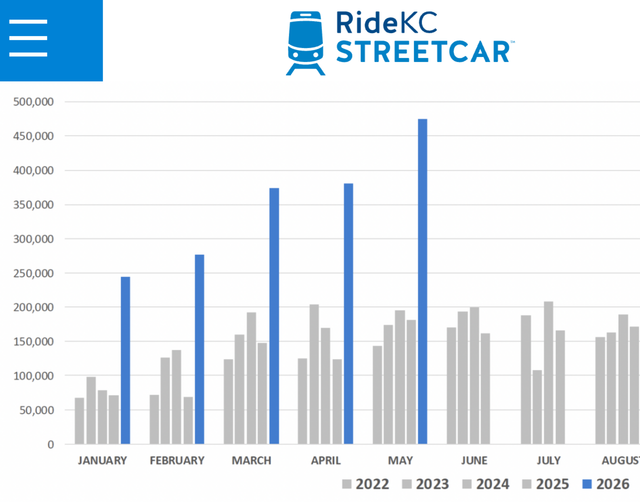
Have you followed KC at all? They've built quite a decent amount of apartment units downtown in the past decade while continuing to convert old warehouse, factory stuff into lofts, apartments or condos. The expanded streetcar line is really helping to tie the inner-city together from the expanding riverfront neighborhood/KC Current women's soccer stadium (so successful it will grow by 5,000 seats) through downtown all the way to the Country Club plaza and UMKC campus.

At Hallmark's Crown Center the new KC Royals stadium is to be built a stone's throw from the streetcar line.

Kansas City's future looks bright to me. But to most it's kind of like a "sleeper" Metro kind of like Minneapolis, constantly improving while most of the country forgets it exists.

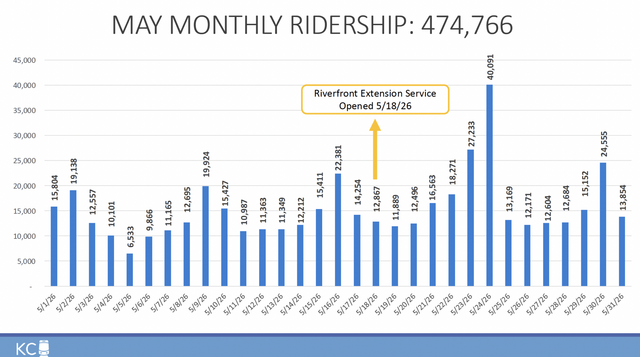
KC streetcar May 2026 ridership numbers. The busiest day after the riverfront extension opened was over 40,000 riders.


Reply With Quote
     
     
End
 
 
Reply

Go Back   SkyscraperPage Forum > Discussion Forums > City Discussions
Forum Jump


Forum Jump


All times are GMT. The time now is 4:07 PM.

     
SkyscraperPage.com - Privacy Statement - Top

Powered by vBulletin® Version 3.8.7
Copyright ©2000 - 2026, vBulletin Solutions, Inc.