Other than Milwaukee, the major midwest land-annexers aren't usually lumped in with the "rust-belt", but when controlled for city core population decline.....
"Old City" Columbus (40 sq. miles):
1950: 375,710 / 9,393 ppsm
2020: 256,939 / 6,423 ppsm
Change: -31.6%
"Old City" Milwaukee (50 sq. miles):
1950 : 637,392 / 12,748 ppsm
2020 : 418,206 / 8,364 ppsm
Change: -34.4%
Center Township, Indianapolis (42 sq. miles):
1950: 337,211 / 8,028 ppsm
2020: 153,549 / 3,656 ppsm
Change: -54.5%
"Old City" Kansas City (60 sq. miles):
1950: 430,535 / 7,176 ppsm
2020: 187,902 / 3,132 ppsm
Change: -56.4%
The divergence here between Columbus/Milwaukee and Indy/KC is pretty interesting.
My guesses:
Milwaukee was helped by its siginifantly higher population density and thus starting out more urban.
Columbus had to have been helped by being home to one of the very largest and prestigious public universities in the nation.
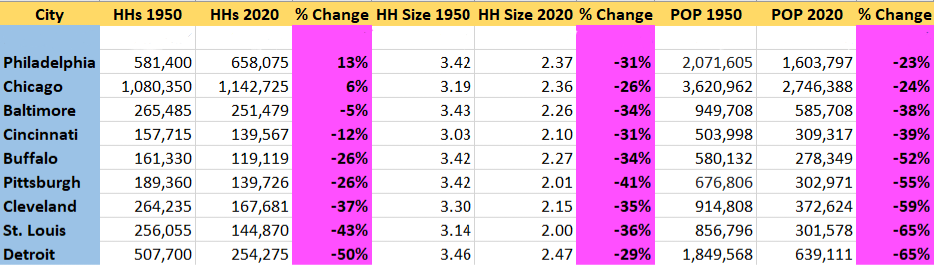
And here are the non-land-annexers for reference:





 Prev
Prev








 Linear Mode
