Quote:
Originally Posted by 38 Geary

Some photos to illustrate. A very diverse crowd, no doubt, but very few actual Asians aside from workers. The most Asians I saw that weren't actually workers was for Molly Tea, a boba shop.
Side note: lots of folks wearing shorts! I remember people on SSP used to say people in Europe don't wear shorts in the city... but I guess things have changed  |
Chinatown in London is a bit of a curiosity, it has a high concentration of Chinese eateries, but demographically, the borough (of Westminster) that it sits in, comes fifth. Barnet, Bromley, Camden and Greenwich have larger Chinese born populations. With that said, London certainly has the weakest Chinese representation versus New York, Sydney and Toronto.
Following the 2021 census, there were three lifeboat schemes that will distort the 2021 census figures
- 310,000 Ukrainians arrived in the UK following Russia’s illegal war. The 2021 census had the Ukrainian population in the UK at just 35,000, of which 58% were resident in London. If you applied that percentage to new arrivals, London’s Ukrainian population could very well be north of 200,000 which is probably the largest change in any foreign-born population in London in such a short period of time
- 170,000 Hong Kongers have already arrived in the UK, with a further 60,000 due to arrive. 38% of the Chinese born UK population lived in London, so it is conceivable that the Chinese born (mainland and Hong Kong) population has risen by 100,000 since the census
- 37,000 Afghans arrived to live in the UK permanently post-census, doubling the population in the UK.
This and the temporary circumstances of the pandemic mean that the 2031 census figures are going to be rather eye-popping.
Quote:
Originally Posted by Docere
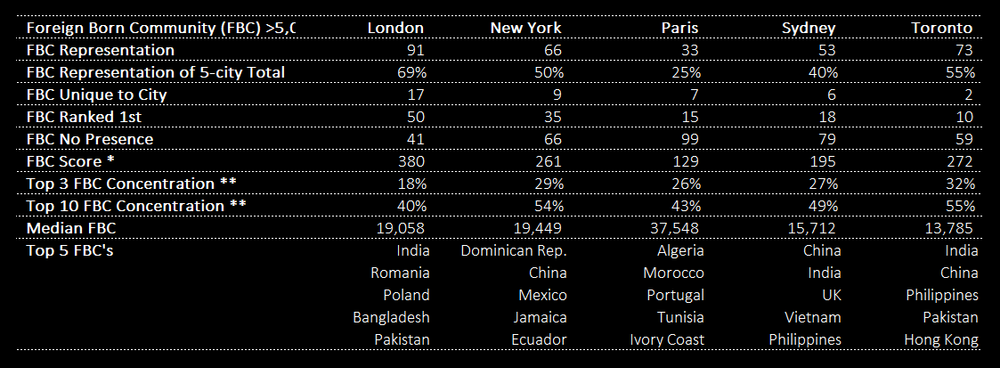
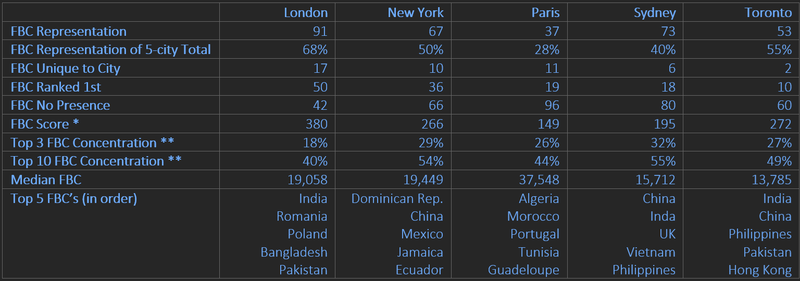
Why did you use NYC (5 boroughs) rather than the Metro Area? Also Toronto is 73 and Sydney is 53.
|
There isn’t one right or wrong definition of what a city is, or the pull it has on its surroundings. Definitions differ. Historical events, physical and urban geography, and political and planning regimes all influence outputs and states of interaction.
I opted to use the comparison of London and New York, as their respective cities alongside the larger urban/metro catchments of Paris, Sydney and Toronto out of curiosity. London’s foreign born population is larger than the City of Toronto or City of Paris for example, so the numbers would have been heavily distorted.
You are correct with the typo, changed.
A few other corrections:
- The Overseas Departments of France (French Guinea, Guadeloupe, Martinique and Reunion) shouldn’t have been included for Paris
- The West Indies is a collection of a dozen plus independent territories and other dependencies, but was lodged for New York

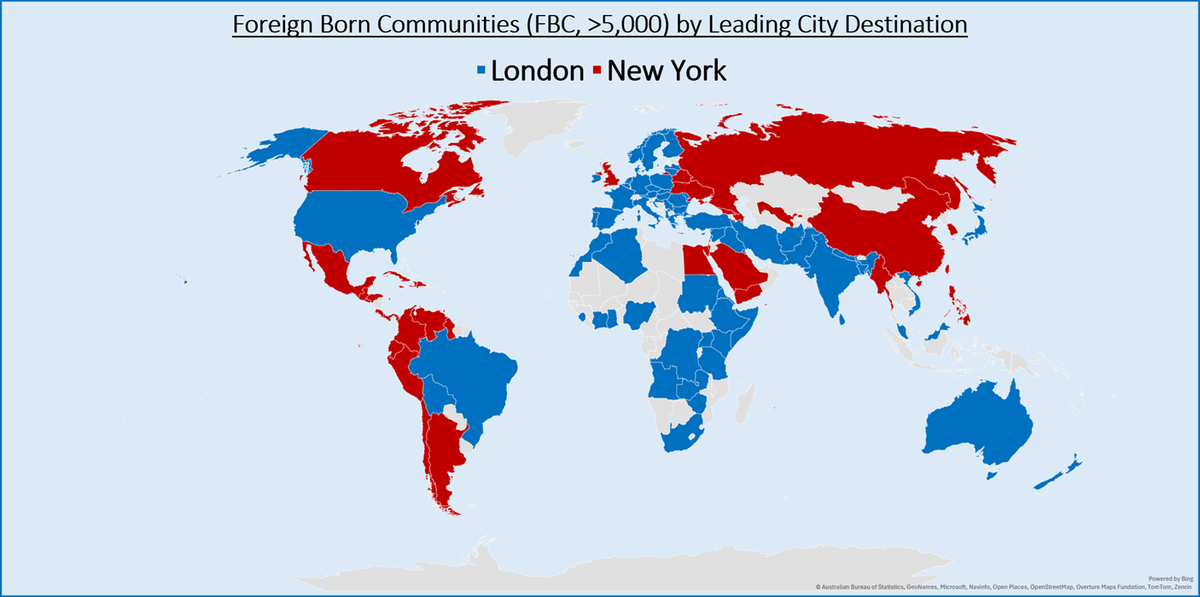
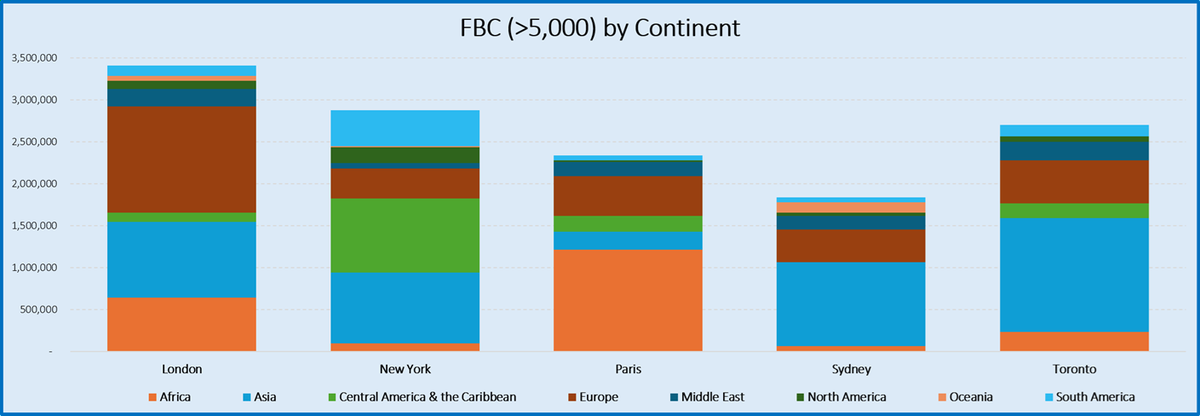
Some further insights based on continent:
- Sydney, Paris and Toronto have FBC’s from >50% of the global total from one continent, Sydney: 55% for Asia, Paris: 52% for Africa, and Toronto: 50% for Asia
- London and New York have the broadest (but different) diversity composition from different regions of the world
- Number 1 destination based on continent:
- Africa: Paris
- Asia: Toronto
- Central America & the Caribbean: New York
- Europe: London
- Middle East: Toronto
- North America: New York
- Oceania: Sydney
- South America: New York
- Across the 5 cities, there are 4.32mn people from Asia, 2.99mn from Europe, 2.24mn from Africa, 1.35mn from Central America and the Caribbean, 0.82mn from the Middle East, 0.80mn from South America, 0.40mn from North America and 0.19mn from Oceania.
Quote:
Originally Posted by Docere
The London foreign born rises to 4.8 million if one includes the "home counties" of Berkshire, Buckinghamshire, Essex, Hertfordshire, Kent and Surrey (and those autonomous local authorities in them). So in other words about half of NYC's foreign born is outside the city limits, but probably about 75% of London is.
And again no real consensus on metropolitan London. Does Milton Keynes count for example?
|
Metro areas, in the American context are mainly focused on connectivity to sprawl rather than connectivity and interaction with the core constituent city ecosystem. Los Angeles and Tokyo both sprawl, but the level of interaction with the core is completely different because there isn’t the infrastructure to facilitate mass transfers of people (whether for work or leisure) in the former versus the later. Paris is normally defined as a city of c. 2mn inhabitants, but really the city goes beyond the Peripherique.
London breaks the definition of traditional metro definitions because sprawl was capped with the implementation of the Green Belt. Which is why when you reach the outskirts of London you see a rapid transition from interwar semi-detached housing to agricultural land and villages.
Milton Keynes has pretty decent transport links to London; a train every 7-minutes with the quickest journey taking just 31-mins over a distance of ~85km, and London undoubtedly acts as a cultural draw (football, theatre, museums, etc…), but it has its own employment base. I wouldn’t count Milton Keynes as part of the London ‘metro’, but then I also think many metro areas are too broad in their application and have very lose tangible connection to their core city.





 Prev
Prev




 Linear Mode
