HomeDiagramsDatabaseMapsForum About
     

Go Back   SkyscraperPage Forum > Regional Sections > Canada > Ontario > Ottawa-Gatineau > Urban, Urban Design & Heritage Issues


Reply

 
Thread Tools Display Modes
     
     
  #1  
Old Posted Mar 13, 2018, 5:17 PM
rocketphish's Avatar
rocketphish rocketphish is offline
Planet Ottawa and beyond
 
Join Date: Feb 2009
Location: Greater Ottawa
Posts: 14,450
Architects and Developers of the National Capital Region

Bill Teron, 1932-2018: 'Father of Kanata' left his mark around the world

Joanne Laucius, Ottawa Citizen
Published on: March 12, 2018 | Last Updated: March 12, 2018 6:54 PM EDT


Bill Teron, right, points to a model of Kanata as architect Ian Johns looks on. Johns was the main staff architect who worked with Teron in Kanata and for many years later.

William “Bill” Teron was, among other things, a developer, a building innovator, a patron of the arts, a philanthropist and a senior public servant.

But to many, he was nothing less than a visionary with a grasp of both the sweeping picture and the small details.

Teron was the last surviving member of the “big three” developers of postwar Ottawa who helped to shape the rapidly-expanding city, along with the Greenbergs of Minto and Robert Campeau. Teron had been hospitalized twice in recent weeks and died early Monday. He was 85.

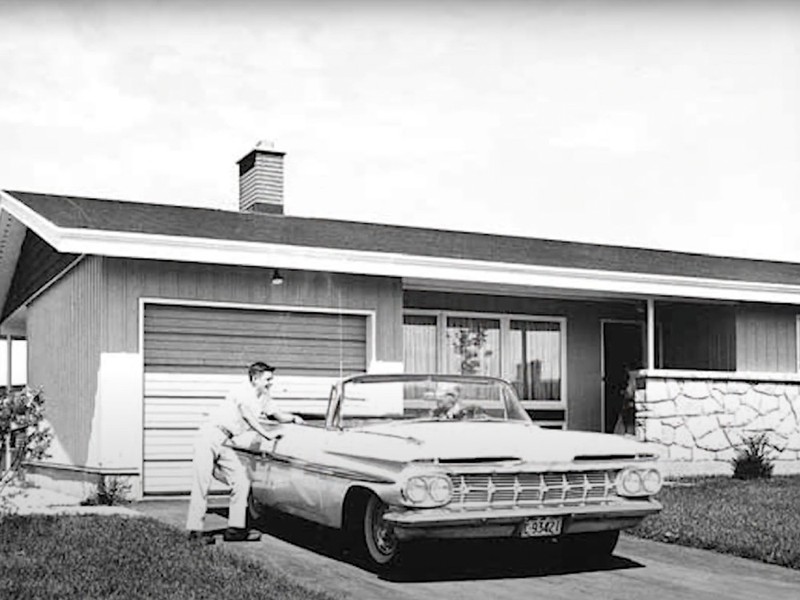
Known as the Father of Kanata, Teron’s claim to fame in Ottawa was creating the “garden city” that became Beaverbrook. Announced in 1964, it was a small town on land gently carved out of the farm fields, woodlots and rocky outcrops Teron had assembled for development outside the greenbelt. Teron would later disparage the “berry box builders” and “garage architecture.”

“This was Tom Thomson,” he explained in one interview. “This was the rugged romantic. The houses are meant to be cottages in the woods. They’re not meant to be peacocks.”

Teron not only built homes, he offered land to technology companies for the price of servicing. Atomic Energy, Northern Electric and Mitel signed up. It was the nucleus of Silicon Valley North, and latecomers would have to pay more.

His influence went far beyond Ottawa. In 1987, he turned over derelict industrial lands in Toronto to the federal government at cost on the promise that the land would be turned into an urban park. The result was Harbourfront.

He was invited by former prime minister Lester Pearson to chair a building committee for a new school for international understanding and co-operation near Victoria, B.C. His company, Teron International, developed building block-type technology, and Teron travelled around the world. He even spent seven years living in an apartment overlooking the State Hermitage Museum in St. Petersburg, Russia, where he was helping to renovate the museum.

“I would be working in the czar’s cathedral, his personal church that no one has seen,” he said in a 2005 interview. “It was one of the most exciting things I’ve ever done.”

Teron was an honorary fellow of the Royal Architectural Institute of Canada, but he never formally studied architecture. Born on a homestead in Gardenton, Man., he and his family moved to Winnipeg when he was 10. He left school after Grade 10 and would later say that everything he built came from deprivation, not privilege.

He arrived in Ottawa at the age of 18, eager to get a slice of the post-war housing boom. His father was a farmer-turned-carpenter who impressed on Teron the idea that the plans were what created the magic. In high school, Teron developed an interest in drafting. “Because that’s where magic is made,” he said in 2005.

Kanata North Coun. Marianne Wilkinson, whom Teron often jokingly called the Mother of Kanata, has lived in the same Teron home since 1968. As part of the purchase agreement, homeowners had to agree to be part of the community association, she says.

“We came here because we understood the concept. You didn’t buy a house. You bought into a community. The attitude is still there.”

Teron began his career as an architectural designer for builder Charles Johannsen, designing custom homes in the Civic campus area and Rothwell Heights. He got his big break at the age of 22, building a house for Jim Scott, then the director general of the Defence Research Board.

Soon after, in 1955, he married Jean Woodwark, the daughter of a United Church minister. The couple had four children: Chris, Kim, Will and Bruce.

Teron’s contracts proliferated. In 1956, Teron’s Lynwood Village in Bells Corners development sparked a kind of gold rush — he sold 218 lots within a few hours. That led to buying up and developing more land in Bells Corners and Qualicum. He next turned his sights on leapfrogging outside the greenbelt, with the idea that he would have to build an entire community, not just the houses.

The Kanata land — 3,000 acres — was held by a conglomerate and valued at $3.3 million. Teron had only a $12,500 down payment, he recalled an interview with this newspaper.

The Queensway didn’t even exist at the time, says Wilkinson. “His idea was to create a satellite city. There wasn’t even a village there. The whole idea was the city in the country. Open spaces, preserving the rock outcrops when possible. There were pathways to where the schools were going to go. Kids still use them.”

March township, as it was then, didn’t have a recreation department, she says. Teron offered tennis courts, a swimming pool, a nine-hole golf course and a riding stable. But Kanata was designed to be exactly the opposite of an upper-class enclave — it was supposed to be a diverse city of apartments, townhouses and single-family homes.

“He always pointed out that his initial plan was more than just large, single-family homes,” says Bruce S. Elliott, a professor of history at Carleton University and author of The City Beyond. Still, Teron believed that his new community needed a strong base of professional-class residents. By 1965, there were already 27 engineers living in Beaverbrook, Elliott notes.

The infamous “covenants” between Teron and home buyers are much-mocked. Among these was an agreement that paint colours must remain in muted shades. “I wanted the community and the homes to be sympathetic to each other and to be organic,” Teron once explained. “So much architecture is shock treatment. I wanted this to be poetic. That’s why I didn’t want straight streets or street curbs. I wanted the streets to echo nature.”

By 1969, Teron had developed Beaverbrook, but 90 per cent of the undeveloped Kanata land still remained, and he needed cash to move ahead with the project. His next move would be the first in a chain of events that end with Teron’s leaving Kanata. He agreed to a merger with Maurice Strong of Power Corp, with the agreement that Teron could veto design ideas. If Strong disagreed, he could buy out Teron’s shares based on the value of the company that day.

Paul Desmarais succeeded Strong at the helm or Power Corp. and proposed merging with developer Campeau Corp. Teron declined to work with his archrival Robert Campeau.

“Campeau and I were like tigers who needed separate cages,” he would later say.

Desmarais opted to veto Teron’s veto, and Teron’s shares were sold to Desmarais for $4.7 million.

Teron was head of Canada Mortgage and Housing Corp from 1974 to 1979, taking on the additional role of deputy minister of urban affairs starting in 1976.

“We had a lot of developers who thought inside the box. Bill was always looking for the new thing and new directions,” says Elliott. “I think that’s why (prime minister) Pierre Trudeau appointed him as head of CMHC.”

Teron was especially proud of CMHC’s Assisted Home Ownership Program, which was designed to appeal to first-time buyers, stimulate the housing market, and help low-income people get the opportunity to buy a home. At the time, mortgage rates hit as high as 18 per cent, says David Crenna, who was then the director of CMHC’s policy development division. Teron understood both the public-sector and private-sector perspectives in this conundrum, he says,

“He played a fundamental role in making housing affordable.”

Among his honours, Teron was an Officer of the Order of Canada, and he was given the Jane Jacobs Lifetime Achievement Award in 2013 by the Canadian Urban Institute for his broad contributions. “There are few people who have a résumé as well-rounded as Bill Teron,” said Glenn Miller, a senior research associate with the institute.

Duncan Edmonds, then a lecturer at Carleton University, met Teron in 1961 when Edmonds was raising money to bring African students to Canada. Teron wrote him a cheque.

“He never said no. He always looked at any idea and tried to examine it as positively as possible.”

Much later, as apartheid was falling in South Africa, Edmonds invited Teron to South Africa to see whether Teron’s modular building system could help with a housing shortage in South Africa. The two returned many times. “He designed, wonderful, low-cost housing,” says Edmonds. “He really was a humanitarian.”

Teron’s son, Chris and daughter, Kim, worked with their father in the company from the time they were teens. Chris said his father would have been horrified at the concept of retiring and worked almost to this last day.

“When the average person thinks of my father, they think of Kanata. That was one of his biggest and best legacies. But that was 50 years ago. There have been a number of things since then,” says Chris.

Even in recent years, Teron was never far from the headlines.

A supporter of the arts, Teron was one of the founding trustees of the National Arts Centre. In 2003, he proposed building a world-class concert hall for free if the city would donate land on Elgin Street.

That same year, he announced that he was leaving the prestigious Canal 111 apartment complex that he built on Echo Drive to return to Kanata to build a 5,600-square-foot home on three-quarters of an acre of woodland in the Kanata Rockeries enclave, part of a parcel he had kept aside for himself. The house had a rooftop garden, and its south side was almost all glass, angled to reflect the sun’s rays in summer and collect them in winter. The north side was buried in a hillside for insulation and to obscure it from public view.

“The reason is as simple as the fact that I’m looking forward to more contemplative time, to more gardening time,” he told this newspaper.

Still, Teron could not refrain from jumping into debate. In a 2007 speech, Teron pitched an idea about developing land in the greenbelt, which had originally been envisioned to control urban sprawl.

Teron proposed that the National Capital Commission sell off about 6,000 acres of the greenbelt to create a 37-kilometre long “belt inside the belt” for medium-density housing with access to rapid transit. It would likely net the NCC around $3 billion, which could be used to buy land for a secondary greenbelt, said Teron, who envisioned small “villages” of 5,000 to 10,000 people, each with industrial or commercial venture.

In 2011, Teron gave an impassioned speech, arguing that infill projects were bringing too much density into neighbourhoods without much thought.

“There’s an unfortunate policy in the City of Ottawa right now, in which it appears that our city government actually encourages and approves random spot zoning anywhere, any place,” he told hundreds of Kanata residents who had gathered over a proposal for a condo tower. The audience gave him a standing ovation.

That same year, he ripped into the National Capital Commission for its refusal to help save a mature forest in Kanata from development. The NCC risked becoming irrelevant by focusing on “nice small” projects, Teron warned. “The NCC mandate was shaping the character of the national capital.”

Later in life, Teron reflected on his disappointments. In 2005, looking back on his 50-year career, he said he regretted that his plans for a Kanata town centre never materialized, and that the rest of Kanata was developed in a conventional fashion. “The greatest regret in my life will be that I didn’t stay, because the rest of the place would have been a cross between Beaverbrook and Kanata Rockeries,” he said.

Teron was passionate about what he did, and the results have stood the test of time, says Wilkinson.

“Bill was a guy who really, really cared about what he did. We love our community because of it.”

Teron’s family will hold a private memorial and internment at the Pinecrest Cemetery.

http://ottawacitizen.com/news/local-news...-saga-with-ripples-felt-around-the-world

Reply With Quote
     
     
  #2  
Old Posted Mar 13, 2018, 9:35 PM
J.OT13's Avatar
J.OT13 J.OT13 is offline
Moderator
 
Join Date: Mar 2012
Location: Ottawa
Posts: 28,354
Quote:
A supporter of the arts, Teron was one of the founding trustees of the National Arts Centre. In 2003, he proposed building a world-class concert hall for free if the city would donate land on Elgin Street.
I forgot about that. So what happened, Teron made a proposal; let me develop the land and I'll give you a free $20 million dollar concert hall. The City said "hey, great idea! Let's have a competition to see who wants to buy the land for peanuts and allow us to build a concert hall out of our own pocket!!" After a year, bureaucrats rejected the free concert hall from the local developer and chose the winning proposal based on a points system that fits in their "box" without consulting the public. The winning Toronto based company bought the land for $6.6 million and the agreement was that space would be reserved for a concert hall, funded by the government and donations ($6.5 mil. province, $6.3 mil. Feds, $12 mil. donations). After years of trying to raise the necessary money, the campaign fell short so Morguard instead gave a good rate to Ottawa Tourism.

In summary, the City rejected a deal that would have seen them ahead by $15+ mil. (not counting the property taxes lost by leaving an empty lot for 10 years) in exchange for a good lease for Ottawa Tourism.

http://www.cbc.ca/news/canada/ottawa/teron-proposes-major-ottawa-concert-hall-1.409417
http://www.cbc.ca/news/canada/ottawa/developer-wants-public-debate-on-150-elgin-fate-1.467856
http://www.obj.ca/index.php/article/city-making-space-ottawa-tourism-150-elgin

This wasn't supposed to be a rant against Morguard. At the end of the day, I think they built a quality building that has enhanced the skyline. They've also done a stellar job restoring Grant House. This was about further exposing the City's ridiculous process that greatly lags in logic and public engagement, something we've seen with the concert hall fiasco, Stage 1 and 2 of the O-Train expansion and now the central library.
Reply With Quote
     
     
  #3  
Old Posted Oct 2, 2019, 5:53 PM
rocketphish's Avatar
rocketphish rocketphish is offline
Planet Ottawa and beyond
 
Join Date: Feb 2009
Location: Greater Ottawa
Posts: 14,450
Architects and Developers of the National Capital Region

Post any interesting profiles of our local architects and developers here...

Last edited by rocketphish; Oct 17, 2023 at 11:06 PM. Reason: Added developers as well
Reply With Quote
     
     
  #4  
Old Posted Oct 2, 2019, 5:55 PM
rocketphish's Avatar
rocketphish rocketphish is offline
Planet Ottawa and beyond
 
Join Date: Feb 2009
Location: Greater Ottawa
Posts: 14,450
Decidedly modern
Ottawa architect Rod Lahey has built a reputation designing contemporary homes like his own: filled with light, clean lines and plenty of space for an eclectic art collection

By Sheila Brady
Luxe Magazine, Fall 2017
Photography by James Park


Rod Lahey is in a reflective mood, musing over a lengthy career that has changed the streetscape of his hometown.

“We are so lucky to live the way we live. Somehow, the stars all lined up,” says the lanky architect, who has a golden reputation for designing crisp condo towers for an extensive list of top builders across Ottawa.

His career has stretched from the late ’80s and the award-winning Sussex House, a red brick condo tucked into a quiet corner of the ByWard Market to a swirling glass highrise, Soho Champagne, in Little Italy.

The man, who is equally intrigued by thoughtful urban planning, is working with mega-developer, RioCan, to reshape two middle-aged malls, Westgate and Lincoln Fields, into residential and commercial hubs.

The 63-year-old architect has certainly carved out his own luck, working long hours, attending countless planning meetings at city hall and navigating confrontational consultations with people worried about intensification coming to their neighbourhood. He did it with patience, determination and a quiet sense of humour.

The non-stop stress likely triggered a heart attack four years ago, launching a new appreciation for the University of Ottawa Heart Institute and a commitment to reassess work and family priorities.

There is now more time spent with carpenter son, Matthew, 34, and a young granddaughter and plans to visit 28-year- old daughter, Samantha, who broke her parents’ hearts, when she recently moved to Vancouver for a job as an urban planner.

There are long morning and evening walks with two standard poodles, Yardley and Liam, and the newest arrival, Beau, a big, gentle mastiff that Lahey and his wife, Carol, found abandoned on the highway near their cottage at Lac Pemichangan in the Gatineau Hills, a 90-minute drive from downtown Ottawa.

Lahey has shed 20 pounds, avoids wine and is a big fan of smoothies. His skin is a rich, nutmeg brown from three-day weekends at the cottage sanctuary and there has been a corporate rebranding, shifting the focus from Rod Lahey Architecture to RLA and his dedicated team of 20. There is also time for lecturing at his old alma mater, Carleton University’s Azrieli School of Architecture and Urbanism.

Yet, the fire to design buildings and plan communities is a driving force.

“I absolutely love what I do,” says Lahey, who grew up in McKellar Park near the Ottawa River, swimming with school chums, often balancing on slippery log booms at the bottom of Woodroffe Avenue.

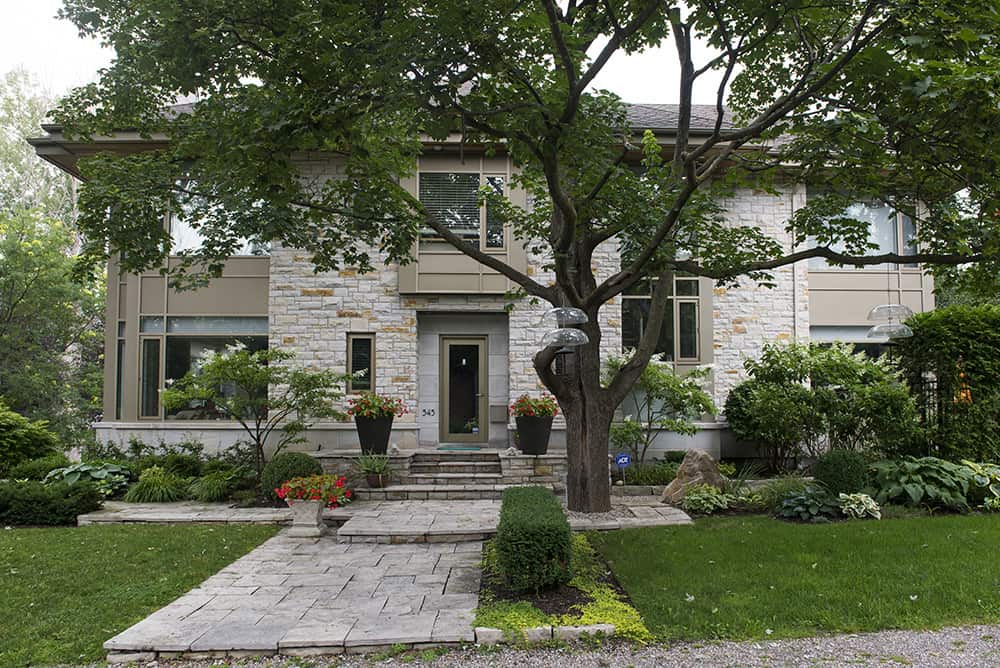
A hefty log rescued from the Ottawa River sits in a shady corner of his Kenwood Avenue home, reminding him of long, sweltering summer days five decades ago. These are his private outdoor rooms, shaded from neighbours by high hedges and decorated with tall grasses and curved iron gates, inspired by photographs he took during a trip to Paris.

The architect grew up in a comfortable household filled with six accomplished siblings, including Brian, a local land developer and Patrick, a determined free spirit, who designs deep sea submarines, exploring magical underwater landscapes with the likes of movie mogul, James Cameron.

Parents, Eric and Ellen Lahey, a pair of leading local realtors, were the sparkplugs, igniting the imaginations of their large brood, appreciating art, as much as wrapping up a successful home sale.

The senior Lahey home was packed with art, likely inspiring their architect son to design his own contemporary stone home in 2006. “I love the way the house works,” says the man, who started out at Algonquin College in the ’70s, wanting to design furniture. A pivotal lecture on Frank Lloyd Wright changed his world, leading to Carleton and a lifelong affair with clean, contemporary designs.

There is not a bit of moulding in the Kenwood home, instead large windows fill the rooms with light, while a profusion of art hangs on the walls and sculptures hold down space on book and window shelves.

The home is a colourful, private gallery and is a testimony to a pair of artistic souls. There are abstracts by leading Canadian painters, joyous folk art and cabinet tops populated by ravens, crows and shiny silver fish.

“There is always more room for art,” he says. “We just move things around. We remember our holidays by the art we bring home.”

There have been magnificent finds, including a pair of brilliant yellow and orange abstracts by Harold Klunder, titled Reinventing Your Self, positioned on a wall alcove in the living room. The two drove to London to be first at a Klunder show, returning the same day with the paintings. The Klunder pieces blend easily with apple green and peachy orange modern furniture by Italian and French masters, Giorgetti, Ligne Roset and Cassina. This is a decidedly modern house.

Eclectic, funky and powerful art also defines Lahey’s architectural offices, located in a converted warehouse in the heart of Little Italy. Five years ago, the Beech Street warehouse was a dusty factory for Sam Holman, creator of Sam Bat, the iconic maple bats favoured by big hitters in the Major Baseball League.

Today, Lahey holds court in a sunny corner office, crowded with drawings he does by hand, a cappuccino coffee machine and lots of art on the walls.

A giant red steel whale by Haida artist, Robert Davidson, is centre stage in the lobby, while clients find a seat on a row of mid-century chairs from Toronto’s Pearson Airport. A pair of powerful photographs of antique BMW motorcycles by the architect’s artist brother, James Lahey, dominates another wall in the main reception area.

And the man who values the art of design and art on the wall, designed the firm’s glass board room to accommodate an oversized painting by Aboriginal artist, Christian Morrisseau, and his father, the northern Picasso, Norval Morrisseau.

Today, there is talk in the Lahey family of simplifying life, finding an empty lot and designing a smaller house on one level. Just like designing a highrise condo for a paying client, the next move takes thoughtful negotiations. The architect would be happy on one level in a highrise, while Carol, wants to stay connected to the ground.

She could live in the country. He likes the city.

There are two givens: The next house will be contemporary, clean and light and there will be subtle niches and large clean walls for an ever expanding Lahey art collection.

Rod Lahey Architects can be reached at 56 Beech St., rlaarchitects.com

https://luxemagazineottawa.com/blog/decidedly-modern/
Reply With Quote
     
     
  #5  
Old Posted Oct 2, 2019, 9:43 PM
Urbanarchit Urbanarchit is offline
Registered User
 
Join Date: Jun 2013
Location: Ottawa
Posts: 1,925
I know that house and didn't know Lahey designed and lives there. I had an acquaintance in high school 10 years ago that I remember walking to this house where I'm sure she lived. But her last name isn't Lahey...

Quote:
The man, who is equally intrigued by thoughtful urban planning, is working with mega-developer, RioCan, to reshape two middle-aged malls, Westgate and Lincoln Fields, into residential and commercial hubs
I'm not sure that I see the "thoughtful urban planning" presented in any of this projects, especially not the Westgate redevelopment.
Reply With Quote
     
     
  #6  
Old Posted Oct 3, 2019, 2:20 PM
McKellarDweller's Avatar
McKellarDweller McKellarDweller is offline
inner city
 
Join Date: Feb 2012
Location: Calgary/Ottawa
Posts: 488
Quote:
Originally Posted by Urbanarchit View Post
I know that house
Me too. While the curb appeal and quality of the home are great, the building's interaction with its private outdoor space to the rear (north) and side (east) are bad to a baffling level. I'm surprised that was such a non-factor in the design.

Edit:
Okay, I forgot, it was originally built close to its north lot line, and I now see it looks like there must have been a severance of the adjacent property giving them some more space to that side. Disregard my above comment. Time to knock out some back wall and add more glass and openable space!

Last edited by McKellarDweller; Oct 3, 2019 at 2:41 PM. Reason: facts
Reply With Quote
     
     
  #7  
Old Posted Mar 19, 2022, 5:48 PM
rocketphish's Avatar
rocketphish rocketphish is offline
Planet Ottawa and beyond
 
Join Date: Feb 2009
Location: Greater Ottawa
Posts: 14,450
Ottawa's urban champion: Award-winning architect Rosaline Hill has lots of irons in the fire

Anita Murray, Ottawa Citizen
Publishing date: Feb 09, 2022 • February 13, 2022 • 5 minute read


Rosaline Hill is a study in contrasts. Architect, bush camping enthusiast, urban advocate, nature lover, entrepreneur, artist, approvals expert, and Ottawa’s designer of the year.

Yet these disparate aspects of her work, advocacy and character are all connected, really, so that the many pies she has her fingers in make sense.

When Hill was named the designer of the year at the Ottawa Housing Design Awards in November, that accomplishment and her three other award wins were enough to merit a closer look.

But she is much more than a multi-award-winning architect.

“She has a lot of irons in the fire,” says builder Rob Haslett of Haslett Construction, who shares office space with her and is a frequent collaborator on infill projects. “I don’t know where she finds the time or energy.”

Hill combines her professional expertise — and an aptitude for the intricacies of the city’s approvals process — with a driving passion for advocacy and creating a true sense of community.

“She naturally gravitates towards making community wherever she is,” says good friend Crystal Hache. “She’s genuinely caring and she really walks the talk, meaning community isn’t just an idea.”

Hill lives in a Britannia triplex (originally bought with Hache), where regular weekly dinners with neighbours have been common. And part of the appeal of being a member of her church — St. Alban’s Anglican in Sandy Hill — is its diverse congregation.

“I have friends there who live at the Mission… who are university students… different gender expressions, so a very interesting place to grow,” says the 49-year-old mother of two girls.

Hill’s community-making extends to her advocacy.

Not only is she a founding member of the Urban Infill Council at the Greater Ottawa Home Builders’ Association (and the industry working group that preceded it), for the past three years she’s devoted countless hours to researching development patterns and the forces that generate change in neighbourhoods, primarily through intensification. That research has led to the building of a simulator to understand and map how intensification could happen in neighbourhoods under different regulatory scenarios. Hill expects the simulator to be ready for demonstrations soon and says the city has expressed interest in the project.

“I hope it will have a really big impact on the way that Ottawa chooses to grow,” she says. “The city is devoted to this general direction, but without modeling and simulation, it’s hard to get there, because you need to really understand the mechanics… to change the trajectory in a very significant way.”

In a sea of negativity surrounding the idea of intensifying (or densifying) our neighbourhoods, Hill is a refreshingly positive proponent — and one with specific ideas on how it should be achieved.

“People are angry because they see infill in their neighbourhood that doesn’t have any logic or purpose behind it… and nobody seems to be driving the ship and it’s frustrating,” she says.

Good infill, and by extension intensification, is not simply replacing a single home with an even larger single home, or a block of homes with a bulky apartment building. It’s about “inside the box” thinking that creates smart multi-unit dwellings that are currently not allowed in the zoning, she says.

“My research into development patterns in neighbourhoods is important because I can demonstrate that we can meet very significant intensification targets without increasing the height.”

It’s also about moving toward neighbourhoods that are walkable, offering all the amenities a resident would need within walking distance and reducing car dependency — also referred to as 15-minute neighbourhoods.

Frustrated by what she saw as lots of talk about the value of walkable neighbourhoods yet little action to figure out how we get there, she started Walkable Ottawa in 2020. The grassroots group is working toward moving that agenda forward, including holding workshops in various neighbourhoods and offering constructive comments during the city’s Official Plan process.

“Walkable Ottawa and the infill modeling are all in an effort to see our neighbourhoods grow in more healthy ways and to get people on board with the idea that our cities can evolve differently,” she says.

Hill’s sense of community has also extended to a new initiative launched last month, called Ottawa Cohousing.

The basic concept is a grouping of homes, often a condo, in which those who choose to live there have done so because they want more community engagement.

“It could be exactly the same as the condominium next door physically, but there’s an intention to be participating,” Hill says.

Started with business partner Linda Kruus, Ottawa Cohousing will bring together groups of like-minded individuals or families and match them to an appropriate developer or builder, then help them through the whole process of realizing their cohousing goal. Hill and Kruus hope to have their first group matched to a site by the end of the year.

It’s a housing arrangement Hill could see herself in at some point, and even did try to organize about 20 years ago. However, at the time she hadn’t yet honed her development expertise and the attempt failed.

A Toronto native, Hill did her schooling at the University of Waterloo and eventually made her way to Ottawa, where she joined the team at Hobin Architecture. That gave her the ability to work on many types of architecture and find her niche in urban infill and development approvals.

“He’s fantastic with approvals,” she says of the firm’s founder, Barry Hobin, “so I was learning from the best.”

For his part, Hobin describes her as a problem solver and communicator, as opposed to a style-driven designer. Although it’s been a decade since she has worked for him (she set up her own firm, Rosaline J. Hill Architect, 10 years ago), he says she is “an individual of great integrity, with insightful understanding of how design can shape a better neighbourhood and the city as a whole.”

Adds planner Murray Chown of Novatech, who shares her interest in infill and intensification and has worked with her in advocating for smart infill: “She certainly is very concerned about the urban neighbourhoods, how they’re going to evolve and mature over time. (She) has a vision that she believes is achievable and will be of tremendous benefit.”

But she doesn’t see herself as an urban champion — “That would be extremely arrogant,” she says — although she does allow that she’s an urban advocate.

“I believe it’s important to speak up and make waves when it matters… If I’ve been given the tools and the abilities and the opportunity to make a difference, then I have a responsibility.”

https://ottawacitizen.com/life/ottawas-urban-champion
Reply With Quote
     
     
  #8  
Old Posted Mar 19, 2022, 6:09 PM
Proof Sheet Proof Sheet is offline
Registered User
 
Join Date: May 2009
Posts: 2,979
Quote:
Originally Posted by rocketphish View Post
[B]Ottawa's urban champion: Award-winning architect Rosaline Hill has lots of irons in the fire
Rosaline Hill is a study in contrasts. Architect, bush camping enthusiast, urban advocate, nature lover, entrepreneur, artist, approvals expert, and Ottawa’s designer of the year.
Very organized and well spoken architect. She is a master at the Committee of Adjustment and doesn't get flustered by the busybody nature of the Commitee of Adjustment. Very good designs.
Reply With Quote
     
     
  #9  
Old Posted Apr 17, 2022, 2:14 AM
rocketphish's Avatar
rocketphish rocketphish is offline
Planet Ottawa and beyond
 
Join Date: Feb 2009
Location: Greater Ottawa
Posts: 14,450
‘A city without intention is just a bunch of buildings,’ local architect argues
Shopify’s office designer says a hockey arena downtown just needs to happen

By: Caroline Phillips, OBJ
Published: Apr 14, 2022 12:29pm EDT


Ottawa-based architect Andrew Reeves remembers a night about eight years ago when he was attending an industry awards dinner at the Shaw Centre. His attention had been focused not so much on the prize that he’d won for best bathroom design, but on a building off in the distance.

That building, still under construction at the time, was the landmark office tower Performance Court. It was also the future headquarters for Shopify. Reeves and his firm, Linebox Studio, had been hired to shape what would eventually become 170,000 square feet of office space spanning 10 floors for the fast-growing e-commerce company.

Reeves was holding his trophy but looking across the street at the big job that lay ahead. “I was freaking out, going, ‘This is everything. This is my career. If we don’t deliver this thing…’”

Not only did Linebox get the job done on time, but the end results were met with awe and excitement at the official opening of Shopify’s new headquarters at 150 Elgin St. in October 2014. There was more Shopify work to come for Linebox – until the pandemic hit in 2020. That’s when the multinational company announced that the vast majority of its employees would work remotely on a permanent basis.

“Right away, I was, like, ‘It’s over, it’s done,’” Reeves recalls of the contracts his firm had with Shopify to design new office spaces in a handful of other Canadian cities. Reeves was disappointed, but he understood and even agreed with CEO Tobi Lütke’s decision, recognizing that Shopify, a publicly traded company, was growing faster than it could build places to work for its thousands of employees. It also wanted to embrace the potential of the digital world and remote working concepts.

On the one hand, Linebox lost 60 per cent of its business as a result of the announcement. On the other hand, Reeves saw an opportunity for the firm to further diversify and to reinvigorate itself with new challenges, while embracing its roots as a forward-thinking architecture and design studio. Linebox also has offices in Toronto and Montreal.

“We are better than we were before because we were forced to get outside our comfort zones,” says Reeves, who works with the commercial, residential, office, mixed-used, multi-unit and hospitality sectors. Clients include Ottawa-based CLV Group, Vancouver-based software company Hootsuite and U.K.-based private health-care provider Harley Street Clinic, to name a few.

Reeves says his company was able to develop a more robust and resilient business model, as one does when soldiering through a pandemic.

“We kind of have that ‘Band of Brothers’ feel,” jokes Reeves, who thinks and talks fast.

The native of Windsor earned his undergraduate and master’s degrees in architecture at Carleton University. Reeves spent 10 years with BBB Architects, which was behind the Shaw Centre and Ottawa airport expansion. In 2005, Reeves launched Linebox, which he runs with his wife, chief operating officer Melissa Reeves. They’re both past recipients of Forty Under 40 awards.

“As an architect, there’s never been more exciting times,” says Reeves of how his industry has been reshaped by COVID-19. “We’ve had an opportunity to redefine everything – our homes, offices, hotels. They’re all being questioned. COVID will fade away and will be something like the common flu, but the human psyche is going to remain changed for a long time.

“We’re defining who we are, we’re defining how workspace can work, we’re defining our culture. To be working with clients who are in the middle of all that is super powerful. That is the thing that gets me going, like in my early days with Shopify.”

Organizations are now trying to decide what the future of the workplace will be for them, Reeves acknowledges.

“I don’t have the answer to say whether you should be working digitally or not. It’s more about them figuring out what their game plan is and then coming to us.”

Linebox, which has a team of 15 people, has decided on a flex-work arrangement of three days in the office and two days at home. Reeves feels the in-person interaction is important for the transfer of wisdom, knowledge and ideas and in building strong trust patterns.

“I know, personally, as a small entrepreneur, a huge part of my motivation to keeping Linebox healthy is the people that are there. The fact that ‘Jon’ just bought a new house, got married and had a kid motivates me to keep the firm going. When all that starts disappearing and I don’t even know these people anymore and they’re just a Zoom call, it changes how you do business,” says Reeves, speaking at the former headquarters of Shopify.

Linebox moved into the space last year, after flexible workplace provider TCC Canada arranged to sublease up to 100,000 square feet of Shopify’s old stomping grounds. It’s currently using just under 50,000 square feet and hopes to fill the balance over the coming nine to 19 months, depending on the recovery time of the pandemic, according to TCC Canada president Sean Cochrane.

“It’s been awesome watching these offices live on for somebody else,” says Reeves, who views the office space as Shopify’s legacy. “There’s no need to tear or rip things out or reinvent the office in here. If you walk around, this is what the future office was then and what it is now.”

Hands down, Shopify ran one of the coolest offices, with its yoga room, indoor slide, gourmet cafeteria and other enviable amenities. It created themed floors with authentic details, not Disneyworld-like facades. Its internal staircase meant its employees could skip the elevator when they wanted to visit someone on another floor. Meeting rooms and office stations were created in thoughtful ways to suit all work styles and personalities. There was even a secret hidden doorway in the CEO’s office, in case he wanted some alone time.

The office wasn’t just like home, it was better than home. And that’s what made the commute worth it.

“I applaud Shopify so much,” says Reeves. “As they take on the world, the buildings they leave behind are fostering, who knows, the next Shopify, the next great startup that may come out of this same space.”

It’s an investment in design that Reeves really respects.

“I find Ottawa, as a city, a bit lost,” he acknowledges. “It’s frustrating as an architect to see opportunity wasted or watered down. We’ll be dead and gone and it’s still there, so what are you building: junk or good stuff?”

He feels the downtown core has, in recent years, constructed too many undistinguished glass towers and grey, generic buildings, leaving it lacking in character, vision and identity.

“I’m very worried about the downtown,” says Reeves. If remote work means fewer people need to come downtown, will they even come at all, he asks. “A city without intention is just a bunch of buildings.”

Reeves believes the ByWard Market needs to be a destination spot designated solely for pedestrians, on par with Old Montreal and the historic neighbourhood of Quebec City. He’d also like to see the Senators’ home arena relocated to the city centre.

“It shouldn’t be a question. It should just happen. You have to make it happen. There’s no ‘what if or maybe not’. These are major moves for a city.”

There are promising developments, recognizes Reeves, who cites the new carbon-neutral waterfront community Zibi as an example. There are also unique features to the City of Ottawa that Reeves believes distinguishes it, including its proximity to nature and its French culture.

“One of the best things to ever happen to Ottawa is that we’re next to Quebec.”

With provincial and municipal elections around the corner and pandemic restrictions fading, the wind of change is in the air, says Reeves.

“I remain ‘negatively optimistic’. It’s a time for great change. We need to start thinking about those big moves and thinking, from every little building to every big building, how it’s something that’s permanent, it’s an investment, it’s something that outlasts us all. And we need to be proud of that because Ottawa is just sitting there and it needs a kick in the ass, maybe.”

https://www.obj.ca/article/local/city-without-intention-just-bunch-buildings-local-architect-argues
Reply With Quote
     
     
  #10  
Old Posted Jun 12, 2023, 9:49 PM
rocketphish's Avatar
rocketphish rocketphish is offline
Planet Ottawa and beyond
 
Join Date: Feb 2009
Location: Greater Ottawa
Posts: 14,450
Taggart Group of Companies celebrates three generations of family leadership at 75th anniversary
Multi-faceted, family-owned business dates back to 1948 when founder Harold Taggart launched small construction business in Ottawa

Caroline Phillips, OBJ
June 12, 2023 1:13 PM ET


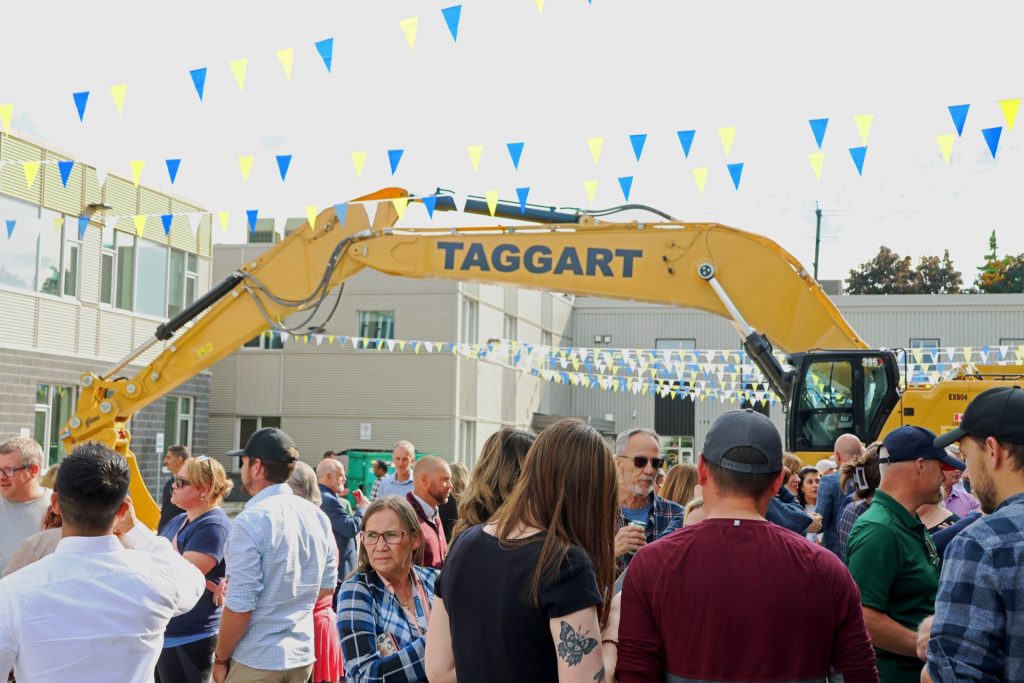
A front-end loader comes in handy for a variety of jobs, including scooping and moving gravel, dirt, sand and other debris. A much more enjoyable use, however, is to put it in park and fill its bucket with ice and drinks, as Taggart Group of Companies did for the 75th anniversary party it hosted Thursday.

Nearly 400 guests turned out to help the family-owned business celebrate its milestone birthday at its headquarters on Albion Road South, not far from South Keys. To accommodate such a large crowd, the gathering was held in the spacious mechanic’s bay located next to the main office building. There was a full-sized yellow excavator on prominent display in the work yard.

In the garage-that-didn’t-feel-like-a-garage were food and drink stations, a trio of musicians and lounge areas to relax in. There were row upon row of hanging pennant flags in the company’s colours, along with dark floor-length velvety curtains that hid whatever tools and stuff were being stored behind them. The place was so spick and span you could’ve eaten canapés off the floor.

As for the anniversary cake, let’s just hope the task of cutting it into hundreds of slices was a team effort. It was so huge.

Taggart Group of Companies is a major player in construction, land development and property management in the region. It consists of Taggart Construction, Doran Contractors, Tamarack Homes, Tartan Homes and Taggart Realty Management.

The family also runs its own private foundation for its philanthropic giving, of which it does both frequently and generously.

Attendees heard briefly from Taggart Group of Companies chairman and family patriarch Jim Taggart, 81, and his nephew, Scott Parkes, co-president of Tamarack Homes and of Tartan Homes.

Back in 1948, Taggart’s father and Parkes’ grandfather, Harold Taggart, began building new homes for returning war veterans. Recognizing an opportunity in servicing the land, Harold went out and bought the biggest shovel he could find to start an infrastructure company, Taggart Construction. He and his wife, Muriel, also raised seven kids: Jim, Martha (who married Dave Parkes), Tom, Ian, Keith, Paul and Chris. Only Paul is no longer here, having passed away in 2018 at age 61.

Over the decades, Harold’s business expanded and grew as Taggart, his brother Ian and their brother-in-law Dave took over. Gradually, their own children, nephews and nieces began stepping into more senior leadership roles. As for the family’s fourth generation, its oldest members are now in university. The Taggart and Parkes clan has grown to 88 family members, of which 17 work for the company.

Taggart Group is a terrific example of a successful multi-generational, family-owned business in Ottawa. “You may wonder how 17 second- and third-generation Taggarts and Parkes can ever arrive at a consensus,” said Taggart, adding light-heartedly: “So do we.”

The truth is, Taggart and his siblings were raised by their parents to stick together and take care of one another, he told OBJ in a 2021 interview. “We hope it will all continue,” Taggart said Thursday of their cohesiveness, while making special mention of their CEO and CFO, Pierre Bergeron, for his leadership role.

Taggart credited their consultants, suppliers and, “most important, our employees, who now number over 600” for the family’s ability to run their business for 75 years, through three generations.

Parkes also thanked the industry partners and employees, past and present, for their contributions to the company’s success. “Together, we accomplished something really special,” said Parkes. “It’s now my generation’s job not to screw it up.”

Parkes spoke that day on behalf of his entire family. “Please enjoy the rest of the evening and we look forward to welcoming you back for our 100th anniversary in another 25 years,” he said to applause and cheers from the crowd.

Among the invited guests were Claridge Homes founder and CEO Bill Malhotra and his son, CFO Neil Malhotra; Ron Tomlinson, CEO of Tomlinson Group of Companies, and its vice-president of construction, Tim Vizena; Melissa Kruyne, co-owner of building materials supplier KOTT Group; Kevin Yemm, vice president of land development at Richcraft Homes with his brother-in-law, Jeff Smith, president of Smith & Reid Insurance; retired Deloitte partner Carman Joynt; John Brulé, owner of JD Brule Equipment; and Syntax Strategic CEO Jennifer Stewart.

Prominent architect Barry Hobin, founding partner of Hobin Architecture, has been working with the Taggart and Parkes family for nearly 50 years. “They’re my longest, most loyal client,” he told OBJ.social.

“They’re a great group to work with,” he said of their willingness to listen and be respectful of other opinions. And they’re decisive, Hobin added. “They don’t go around in circles.”

Taggart Group COO Derek Howe has been with the company for about six years, which is nothing compared to the folks who’ve been there 10, 20, 30, 40 and 50 years. “I think that says a lot about what kind of place it is to work for,” he said of the long-term employees. “The family organization is exactly that — a family. Everyone looks out for each other.”

Howe described Taggart as “the heart and soul” of the company. “He still comes in here every day and he takes the time to talk to as many people as possible.”

In 2021, Taggart was honoured with a lifetime achievement award from the Ottawa Board of Trade and Ottawa Business Journal.

[email protected]

https://obj.ca/taggart-group-celebrates-family-leadership-anniversary/
Reply With Quote
     
     
  #11  
Old Posted Sep 3, 2023, 1:46 AM
rocketphish's Avatar
rocketphish rocketphish is offline
Planet Ottawa and beyond
 
Join Date: Feb 2009
Location: Greater Ottawa
Posts: 14,450
Raymond Moriyama, Canadian architect who designed Ontario Science Centre, dead at 93
Moriyama's work, including Canadian War Museum, Ottawa City Hall, had immense impact on Canadian architecture

Lane Harrison · CBC News
Posted: Sep 02, 2023 7:17 PM EDT | Last Updated: 2 hours ago


Raymond Moriyama, the Canadian architect who built his first structure in a B.C. internment camp during the Second World War and went on to design some of Canada's most iconic buildings, has died at the age of 93.

Moriyama died on Friday, according to a statement from his firm, Moriyama & Teshima Architects. A cause of death has not been released.

"We ask for particular respect and privacy for Raymond's family. The world has lost a visionary architect and they have lost a treasured loved one," the statement said.

Born in Vancouver in 1929, Moriyama had a hand in the creation of the Canadian War Museum, Ottawa's City Hall, the Bata Shoe Museum, the Toronto Reference Library, the Ontario Science Centre and the Canadian Embassy in Tokyo.

Moriyama founded his architecture firm in 1958, according to the firm's website, and later joined with Ted Teshima in 1970 to form Moriyama & Teshima Architects.

He was named a Companion of the Order of Canada in 2009, the same year he won the Governor General's Award in Visual and Media Arts.

Moriyama was one of the greatest Canadian architects of the 20th and early 21st century, if not the greatest, according to Stefan Novakovic, a senior editor at architecture publication Azure Magazine.

"The era in which he sort of came of age and started designing was what we sometimes look at as a sort of golden age of Canadian architecture after World War II," Novakovic said.

"It was this time when we were transforming Canada from this sort of white colonial nation into the multicultural and diverse country that we know today."

That transformation included a desire to express the shift architecturally, which he said Moriyama's buildings do well.

"With Moriyama's buildings, the really beautiful thing is, you don't have to know much, you just have to feel it. You step into the Toronto Reference Library and you feel that this is an inclusive space where everybody's welcome," Novakovic said.

When it comes to the Ontario Science Centre, Moriyama innovated what a museum could be, said Richard M. Sommer, the former dean of the John H. Daniels Faculty of Architecture, Landscape, and Design at the University of Toronto.

Before the science centre, Sommer said "museums were very, very static and very much about displays and reading. And this is a museum where people were asked to kind of engage very haptically in the material."

The science centre was also the building that launched Moriyama's career, Sommer said.

This summer, Toronto city council voted in favour of exploring the feasibility of keeping the science centre in its current location. That followed Premier Doug Ford's stated plan to relocate the science centre to Ontario Place, demolish the current site and build housing in its place.

Moriyama & Teshima Architects commented on the proposal in a June 1 post on CanadianArchitect.com, noting that the brief given to Moriyama by the Minister of Public Works in 1964 read: "Design an institution of international significance."

"The Ontario Science Centre is a landmark building, purposefully nestled into the natural ravine of the Don Valley, where it has succeeded in bringing that joyful study to the masses for over fifty years," the post read. "The purpose of the Science Centre is inseparable from the site it currently inhabits."

As a child, Moriyama spent time in a British Columbia internment camp during the Second World War.

Between 1942 and 1949, more than 22,000 Japanese Canadians were forcibly removed from the B.C. coast and incarcerated in camps. Japanese Canadians in B.C. were labelled as enemy aliens during the Second World War despite many of them having lived in Canada for generations.

In 2010, Moriyama reflected on the experience in a speech while receiving the Sakura Award for contributions to Japanese culture in Canada and abroad.

"It is a psychological hell when your own country, the country of your birth, stamps you an 'enemy alien,' disowns you and expels you," he said according to an excerpt of the speech published by the University of Toronto.

At the public baths in the camp, Moriyama was bullied because of scars from a childhood injury. Rejected by the country where he was born and mocked by those who shared his heritage, he snuck away to the Slocan River near the camp to bathe.

"Soon, I found myself wanting to build my first architectural project, a tree house, without being found out by the RCMP," he said. "That tree house, when finished, was beautiful. It was my university, my place of solace, a place to think and learn."

There, he said his despair began to subside and he realized he could not hate his own community and country, as it would crush his imagination.

"I replaced the despair with ideas about what I could do as an architect to help my community and Canada," he said at the time.

With files from Tyler Cheese, Guy Quenneville and The Canadian Press

https://www.cbc.ca/news/canada/toronto/raymond-moriyama-obituary-1.6955919
Reply With Quote
     
     
  #12  
Old Posted Oct 5, 2023, 11:38 PM
rocketphish's Avatar
rocketphish rocketphish is offline
Planet Ottawa and beyond
 
Join Date: Feb 2009
Location: Greater Ottawa
Posts: 14,450
OBJ talks housing with Minto Group president Brent Strachan as Minto celebrates 100,000 homes built

Sarah MacFarlane, OBJ
October 5, 2023 1:50 PM ET


In 1955, Minto Group, then called Mercury Homes, was founded in Ottawa. In 1968, it built the first condo in the city. Last week, the developer realized its 100,000th home in Canada. OBJ’s Sarah MacFarlane sat down with Minto Group president Brent Strachan to discuss the challenges facing the housing industry, how the public and private sectors can help, and what the future holds for Minto.

What are the biggest challenges that you see facing the industry at this time?

I think the costs, number one. There’s that escalation that we’re seeing everywhere across everything, whether it’s food prices, labour costs or hard costs for construction. But also just the market today and the overall economy is just making people nervous about where the economy is today and where it’s going. There’s a lot of hesitation from people to even put their house up for sale or to buy a new home.

Hopefully, with some rate holds and, ideally, some rate drops later this year or early next year, it could provide a bit of positivity for people to get back into the real estate market. With the interest rates comes the financing, too. So, of course, the financing and the cost to carry is a factor as well.

How do you see the recent announcement about the federal government’s changes to the GST impacting the industry?

It’s a positive step in the right direction that will certainly help. There’s lots of headwinds in the industry today, from hard costs, development costs and labour costs, to financing costs, and with today’s interest rates, all of those are making development that much harder. So incentives like this will definitely help.

We hope the governments and the industry continue to talk to see what other opportunities there are, but it’s definitely a step in the right direction to get purpose-built rentals under construction.

What can various levels of government do to support and streamline housing development?

I think the approval timelines are always a challenge, right from purchasing a parcel of land and getting it through approvals. We continually work with the city, for example, to try and streamline the process and the city is always focused on it as well. That’s probably one of the biggest areas just to keep things moving quickly and keep them on.

There’s also the issue of land availability for development. Ottawa has just gone through an urban boundary expansion, but those lands that were just brought in won’t see development for about six years. It does take a long time to get it to development. So I think the land availability increases the supply and the supply definitely helps to address the demand in the market.

How can the private sector contribute?

The private sector, as far as owning land that is developable, is finding ways to bring it to market. But that’s easier said than done, especially in today’s market. In particular, the Ottawa market is down significantly year over year. I don’t think that comes as a surprise to anyone, just with the current state of interest rates today. But one thing that would also help is the stress test. What people need to qualify to get a mortgage these days, eight to nine per cent, is definitely limiting people. To even qualify for a mortgage, let alone buy a house, is a challenge that hopefully the different levels of government are looking at.

From an industry perspective, we need to be innovative with the product. For us, we brought on this year in Kanata new homes under $400,000 and we’re just launching in Barrhaven this weekend with new homes under $400,000 as well. These are stacked condos with underground parking but they’re under $400,000. So I think from an industry perspective, it’s about getting innovative with product design and land use to try and bring in a product that is attainable for the average consumer … which is hard to do with today’s land values and all these costs.

How has the industry changed in Minto’s lifetime?

It’s evolved. With land prices the way they are, it takes a lot of capital to be able to just buy land to build houses — not that it was cheap before, but it could be financed. It’s also how the business has grown and the competitiveness of it. Coming back to the constrained land supply, it really comes down to the land-planning principles that are used, as well as all the costs that are associated with it. It has all just shot up, in particular in the last five years, significantly, which just makes everything that much tighter through the whole process. One point to how things have changed is we’ve done a number of net-zero homes in Ottawa; we just opened one in Markham as well. From a build form and building perspective, houses are built way better today. Stricter code, stricter performance.

The drive towards net zero is, I think, accelerating for high-performance homes, so a home built today is quite a high-performing home compared to 68 years ago when we started. But that is where I think the industry is going and, quite honestly, where I think the housing industry has to go.

How has Minto been working to achieve its goal of building net-zero homes?

It’s definitely a priority. We’ve done at least eight demonstration homes over the last number of years and each one gets a bit better, but what’s important is that each one costs a little bit less, which means it starts to get a little bit more attainable for the average purchaser. These extra components do add costs, obviously, but with technology and advancements, it’s getting within reach. When we get there will be determined, but that’s positive news. In the meantime, our approach is for our homes being better than code and high-performing. Obviously, most consumers are very interested in their cost to carry, whether it’s their heating bills, their gas or electric bills. So high-performing homes, as well air quality within those homes, we feel are very important to buyers these days.

That’s no small feat, 100,000 homes in Canada. What does this milestone mean to Minto?

Well, it’s a homegrown Ottawa success story; what’s not to like? One hundred thousand homes across the company is a significant milestone that only a select few companies — definitely in Canada and even in the United States — can achieve, so I think it’s a testament to the team over the last 68 years to deliver so many homes.

But it’s not just the homes, it’s the communities as well that have been built. Operating in originally just Ottawa, Toronto and Florida, but now closing homes in Calgary and soon Vancouver and Texas, shows the expansion that Minto has been through and the growth in the last decades. Moving into the future, towards the next achievement, the next 100,000 probably will be a lot quicker. With the expansion, we’re not only growing in the market that we build in today, but we’re expanding into new markets. We’re building more where we are operating and we’re moving into new markets to build a diverse offering of building types, from townhomes to single-family homes to condos and everything in between. We’re really just trying to find that diverse market and appeal to many different types of buyers.

You’ve been at the company for 24 years, and Minto has been around since 1955. What does it take for a developer to survive and succeed to this degree?

It all goes back to the original founders of the company, the founding Greenberg family, and the shareholders who have sustained and built the business over the years. I think how they’ve done it is impressive.

The company started in Ottawa, but how they diversified geographically, as well as with different build forms — going back to the first highrise condominium in Canada that was built in Ottawa in 1968 — it’s always been a company of firsts. You know, in our industry, you’ve got the peaks and valleys, and you’ve got the real estate cycle, so it really does take a vision and a strategy to survive all of the down times and maintain success throughout what we call the strong markets.

You say that Minto is already looking ahead to the next milestone. How do you plan to accomplish the next 100,000 homes?

In today’s real estate market, as we’re all seeing, the biggest challenge is affordability and attainability, so how we design not only our homes but our communities and all the different build forms will be essential.

Of course, we have the large rentals division and (real estate investment trust), as well, which is separate from the 100,000, but also from a residential perspective, we’re offering all build forms. Leveraging everything that’s been established and built over the 68 last years to continue on the tradition and legacy of building firsts, trying new things, and pushing the envelope to deliver a product for consumers that they want and can afford, will be the key moving forward.

First as Mercury Homes and now as Minto Group, the company has been around for 68 years. How has Minto responded to the challenges it has faced in the company’s lifetime?

Going back, there would be periods, significant downturns, where the company, in a down cycle, shifted over to building rentals. It wasn’t the case that, when houses weren’t being sold, Minto shut down. Minto shifted over to building rentals in Ottawa and Toronto. So people were kept busy and the product was still being built.

There’s the example of 2008 in Florida in the United States with the market crash. Again, our Canadian operations were able to help out and sustain that Florida operation to make it through the downturn, to a point where now our Florida division will close over 2,000 homes this year alone, which is impressive for a private company in the U.S. So, I think those are examples of navigating through the ups and downs, but also on the employee base, keeping everybody busy and the fiscal prudence of not overextending.

Also, partnering, and good partnerships with our trade partners, has been key over the 68 years. Trade partners have been literally a partner with Minto. They were treated fair and treated honestly and a number of those companies that were partners years ago, even decades ago, are still trade partners today. I think that approach to the business helps toward the success, as well as the stability, of the ongoing legacy at the company.

What are some of the most significant advances and victories that you’ve seen in the industry over your career?

I think one thing Minto has always been proud of is we’ve been been recognized as Ontario’s Green Builder of the Year from the province, as well as Ottawa and Toronto, for our advancements towards net zero, our leading buildings from a highrise perspective, and our performance across the board, so I think that’s something that is closest to all of us as a team. But also, the way that the company and founding family give back to the community, recognizing that. To be successful for 68 years is not something that just happens. It’s about recognizing that giving back to the cities we operate in is important because a healthy, vibrant city is key to everybody. That’s something everyone is proud of over the last 68 years, for sure. There have been generations of Minto employees. This milestone is a celebration not only of employees today, but every employee who worked over the years and helped build the company up to the size that it is today. So it really is a team effort and team recognition dating all the way back for all the employees. I’m getting close to a quarter-century club here at Minto. People say, ‘Wow, you’ve worked at the same place,’ and I think… one job, but many different careers at Minto. It’s a testament to the company and what it stands for.

https://obj.ca/housing-president-brent-strachan-minto-100000-homes-built/
Reply With Quote
     
     
  #13  
Old Posted Oct 17, 2023, 11:08 PM
rocketphish's Avatar
rocketphish rocketphish is offline
Planet Ottawa and beyond
 
Join Date: Feb 2009
Location: Greater Ottawa
Posts: 14,450
Beyond the bricks and mortar

Laura Byrne Paquet, Ottawa Citizen
Published Oct 17, 2023 • Last updated 8 hours ago • 3 minute read


When brothers Louis, Gilbert, Irving and Lorry Greenberg built their first modest house in Ottawa’s Heron Gate neighbourhood in 1955, they probably didn’t dream that their development firm would build its 100,000th residential property 68 years later.

The brothers called their fledgling company Mercury Homes. Two years later, they renamed it Minto Construction Company. And in late September 2023, what is now the Minto Group announced the closing of its 100,000th home. That figure that includes houses, townhouses and condominiums, but not purpose-built rentals.

The company currently employs just over 1,400 people across North America. It has 5,827 units under construction — for both rental and sale — in 23 projects across the continent, including 664 units in five Ottawa developments.

Brent Strachan, President, Ontario at Minto Communities Canada, credits the company’s success to several factors, especially design.

“When I say design, it’s not just about the outside façade. It’s also about the suite and design layouts. [Minto] has always been strong at delivering a product that is very livable,” he says. Over the years, Minto has won multiple awards for design, including all six Ontario awards handed out by the Canadian Housing Design Council in 1969–70.

Strachan notes that the company embraced innovation from its earliest days, pointing to Horizon House, today known simply as The Horizon. The 11-storey tower on Meadowlands Drive in Nepean was Ontario’s first high-rise condominium building when it opened in 1968.

In recent years, that focus on trying new things has also led to a series of environmentally friendly projects and green building awards. Minto has built 10 net-zero demonstration homes since 2008 and it constructed one of Canada’s first LEED-certified condo towers (the Radiance at Minto Gardens in Toronto). The company is currently building North Oak Tower 3 in Oakville, one of the first high-rise condos in the GTA to be heated and cooled with a geothermal system.

Since its beginnings in Ottawa, Minto has steadily expanded to other regions, starting with Florida in 1978. Why Florida? It appealed to the Greenbergs due to a combination of land availability and population growth, Strachan explains.

Later expansions saw the company start building in Toronto (1986), Calgary (2012) and elsewhere. It recently broke ground on rental buildings in Greater Vancouver and Greater Victoria, two new markets for the firm.

Entering a market with purpose-built rentals is a common approach at Minto. It allows the company to become familiar with local tradespeople, building requirements and design preferences, and to test new materials and technologies, Strachan says.

With that understanding of local conditions, the company moves into building homes and condos for buyers.

Strachan believes that strategy differentiates his company from many of its competitors. He says it is possible for someone to start in a Minto rental apartment and move from there into an entry-level stacked townhouse, then a single-family home. Once the kids have flown the nest, homeowners could move into a Minto condo or bungalow, or even a retirement property in Florida.

He also notes that Minto builds more than homes. In many cases, it designs complete communities, including amenities such as parks and schools. The many Ottawa neighbourhoods that Minto helped create include Pineview, Beacon Hill South, Tanglewood, Crystal Beach and Qualicum.

The company’s momentum hasn’t stopped. In May 2022, in one of the priciest land deals in Ottawa’s history, Minto paid $245 million for 212 acres of land straddling the Kanata-Stittsville border. There, it’s building a development called Abbott’s Run, with options ranging from townhouses starting at $646,900 to five-bedroom homes starting at $1,091,900.

Strachan notes that Minto is also working to address the current housing affordability requirements with projects such as Anthem, which opens to buyers today. Stacked, two-bedroom townhomes in the Barrhaven development will start at the high $300,000s.

Since the company builds roughly 1,000 units a year in Ottawa, many Ottawans have probably lived in a Minto-built property at some point. However, even those who haven’t are likely familiar with the company’s name through its community initiatives. For instance, Minto donated $25 million to the Ottawa Hospital and $250,000 to mental health and wellness services at the Orleans Health Hub in 2022.

One of its best-known and most popular charity projects is the CHEO Dream Home. Since 2001, Minto has built every one of these mansions, which have helped raise millions for the Children’s Hospital of Eastern Ontario through the Dream of a Lifetime Lottery.

This year’s CHEO Dream Home, a 4,383-square-foot mansion in the Mahogany area of Manotick, is valued at just over $3 million (including furnishings). Ticket sales close on Friday, Dec. 15.

https://ottawacitizen.com/life/beyond-the-bricks-and-mortar
Reply With Quote
     
     
  #14  
Old Posted Oct 19, 2023, 1:24 AM
J.OT13's Avatar
J.OT13 J.OT13 is offline
Moderator
 
Join Date: Mar 2012
Location: Ottawa
Posts: 28,354
I'd love a map that identified which developers built what.
Reply With Quote
     
     
  #15  
Old Posted Feb 28, 2024, 12:05 AM
rocketphish's Avatar
rocketphish rocketphish is offline
Planet Ottawa and beyond
 
Join Date: Feb 2009
Location: Greater Ottawa
Posts: 14,450
Montreal firm Provencher_Roy acquires Ottawa’s GRC Architects

David Sali, OBJ
February 27, 2024 4:27 PM ET


Montreal-based architecture firm Provencher_Roy has acquired Ottawa’s GRC Architects in a move that will create one of the capital’s largest companies in its field.

The firms announced the transaction on Tuesday. Terms were not disclosed.

Founded in 1985, GRC Architects was Ottawa’s seventh-largest architecture firm before the merger with a staff of eight registered architects, according to OBJ’s 2024 Book of Lists. Its past projects include the Canadian War Museum (a joint venture with Moriyama Teshima Architects) and the embassies of Kuwait and the United Arab Emirates.

Provencher_Roy was founded in 1983 and has worked on a number of major projects in Montreal, including the World Trade Centre Montreal and renovations at Pierre Elliott Trudeau International Airport.

The firm has had a presence in Ottawa for five years, according to a company news release. It said the acquisition will give the firm “the opportunity to further increase its activities in Ontario and the National Capital Region, in addition to pursuing new Canada-wide opportunities.”

Former GRC principals Martin Tite, Alex Leung and Carolyn Jones will now become partners at Provencher_Roy, joining Jenny Lafrance, who has managed the firm’s Ottawa team for the past five years.

https://obj.ca/provencher-roy-acquires-grc-architects/
Reply With Quote
     
     
  #16  
Old Posted Jul 30, 2024, 5:20 PM
J.OT13's Avatar
J.OT13 J.OT13 is offline
Moderator
 
Join Date: Mar 2012
Location: Ottawa
Posts: 28,354
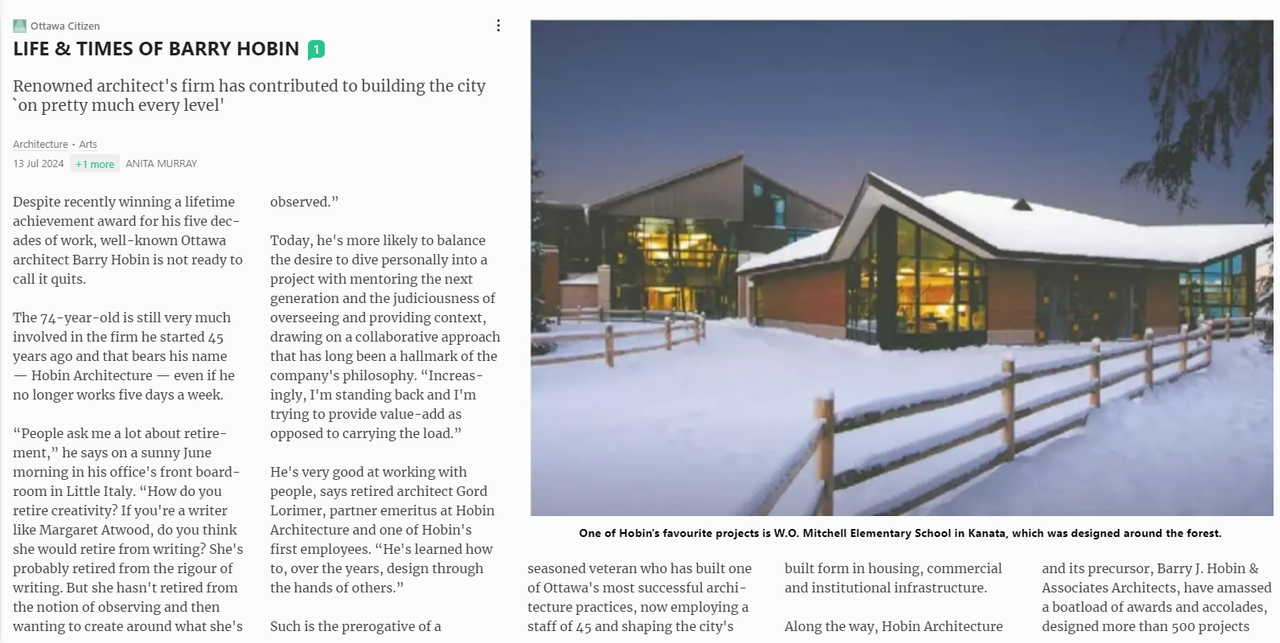
For some reason, I was unable to find this article on the Ottawa Citizen's website, so here are screenshots form PressReader.

https://www.pressreader.com/canada/ottawa-citizen/20240713/282260965687403


Reply With Quote
     
     
  #17  
Old Posted Aug 6, 2024, 1:42 PM
J.OT13's Avatar
J.OT13 J.OT13 is offline
Moderator
 
Join Date: Mar 2012
Location: Ottawa
Posts: 28,354
Sustainability efforts pay off for Windmill Development Group

Author of the articleaul Barker
Published Jul 24, 2024 • 2 minute read


A local developer with a number of major projects in Ottawa and throughout Ontario has won a rare award from a U.K.-based consulting firm called Bioregional for its sustainability practices.

Windmill Development Group has received what is known as a Global Leader endorsement under One Planet Living (OPL), a framework developed by Bioregional in association with the World Wildlife Fund.

Made up of 10 principles, the goal, according to a release issued by Windmill, is to “design residential and mixed-used projects in which residents can live healthy and happy lives while minimizing environmental impact.”

What Windmill has earned is a “Global Leader” endorsement from Bioregional, representing the first time a North American-based company has received such a distinction.

Sue Riddlestone, CEO and co-founder of Bioregional, said that being a Global Leader enables potential for far-reaching systemic change through use of its One Planet Living (OPL) framework.

“Windmill has embedded One Planet Living into its culture more deeply than any other company, and they are encouraging their partners and the wider industry to follow suit,” she said.

Any organization applying for the designation must submit an action plan to Bioregional that is closely scrutinized. Key elements of Windmill’s OPL plan included health and happiness, equity and local economy, culture and community, land and nature, sustainable water, local and sustainable food, travel and transport, zero waste and zero carbon energy.

The OPL framework is currently in place at 10 of Windmill’s projects including: The Baker District North (177 units) and The Baker District South (178 units) in Guelph; 2444 Eglinton Ave East (918 units), Courcelette (56 units), Hälsa (174 units), Jane Bloor (103 units), all in Toronto; and Stone Abbey (22 units), The Evergreen (117 units), 384 Arlington (297 units) and Parkway House (555 units), all of which are in Ottawa.

All 10 projects, says Jeremy Reeds, president of Windmill, are being built to adhere to the framework, which he describes as “taking everything under sustainable, everything under social, everything under governance and putting it in one package. “

It really takes the full lifecycle approach to development. It’s not just about how does your building get built. It is about how does your building impact your community, your neighbourhood, the people that live in the building, the people that live in the neighbourhood.”

He adds that OPL “helped us look holistically at Windmill’s business to ensure our sustainability practices positively impact residents’ health and happiness in tandem with the environment.” Initiatives that resulted in the Global Leader endorsement included the following:

■ Targeting 10 per cent of affordable homes across its portfolio, a goal the company says is “irrespective of government subsidies.”

■ Ensuring 100 per cent of new projects are zero carbon, combustion free and have operational carbon verified through LEED or Zero Carbon Building Standards review.

■ Ensuring over half of residents in new developments can have access to food growing space and/or a community kitchen.

■ Committing to 90 per cent construction waste diversion from landfill.

OPL, says Reeds, “goes beyond the built form. It aims to transform the way we live.”

https://ottawacitizen.com/life/sustainability-efforts-pay-off-for-windmill-development-group
Reply With Quote
     
     
  #18  
Old Posted May 10, 2025, 2:12 PM
rocketphish's Avatar
rocketphish rocketphish is offline
Planet Ottawa and beyond
 
Join Date: Feb 2009
Location: Greater Ottawa
Posts: 14,450
Ottawa architect Jane Thompson looks back on 30-plus years in a male-dominated industry

Marissa Galko, OBJ
May 9, 2025


Thirty years ago, Jane Thompson had just moved to Ottawa with her newborn daughter, wanting to find her place in the world of architecture.

From the time she was in school until she started her own firm in 1995, Thompson said she found architecture to be a tough gig for women.

“My older male bosses didn’t see me as equally capable (of) doing my work, no matter how hard I worked. That was part of why I started my firm, because it just felt like I wasn’t going to be respected,” she said.

All the top architects were male, Thompson recalled, and she was often the only woman in the office.

Even as she built her business, Jane Thompson Architect, she said she began focusing on residential design as clients were “more likely to trust a woman with residential, home-based projects than commercial ones.”

“Not that that wasn’t what kind of work we wanted to do anyway, but I think we carved out a place (for ourselves) by being very supportive of the client rather than having a strong image ourselves,” she said.

Gender parity has improved, Thompson added, with many architecture firms now being woman-owned or, at least, having more than one female employee. But even today, people mistake Thompson’s female leadership team for men.

“We have three senior people in our office named Jane, Erin and Amie. Once a month, I’ll get one of us called James, Aaron or Eric and Arnie. Even today, when people see a female name in an email, they turn that in their heads into a male (name),” Thompson said.

And despite some progress, there is work left to do. Thompson said that a group called Building Equality in Architecture Capital Region (BEACAP) continues to advocate for equity in the industry in the national capital.

A graduate of the Waterloo School of Architecture in 1988, Thompson worked for about 10 different architects by the time she graduated and for a few years afterward. She started her firm in Ottawa in the ‘90s, all while caring for her children.

The firm started small, Thompson said, but she was eventually able to hire part-time students from Algonquin College and Carleton University.

“Over time, we grew a little bit. We started in my home. I had an addition built on the side of my house, then we moved to a real office about 15 years ago,” she said.

Though she had years of experience when she started her business, Thompson found it difficult to get going as her contacts and experiences from when she lived in Winnipeg “didn’t translate very well to Ottawa.”

Over the years, her firm had to diversify its services to weather economic uncertainty.

“Architecture firms are often the first ones to feel the pinch. We’ve had to keep ourselves relatively small and adjust (by) having a range of different projects. When new construction or commercial was down, we did more energy-efficiency and retrofits of houses,” she said.

Today, Jane Thompson Architect has grown and changed as much as the industry itself. For example, when she began, Thompson drew every design by hand – a far cry from the digital three-dimensional modelling used today.

Thanks to evolving technologies and hard work, she said she has been able to grow her business beyond the residential work she started with. Her portfolio now includes projects with the Canadian Aviation and Space Museum and the Central Experimental Farm as well as restaurants such as Tavern on the Falls, Tavern on the Hill and Tavern at the Gallery.

With a life-long passion for environmental studies, Thompson has also undertaken larger-scale projects, including conducting environmental research for the residential sector.

“(We’re) looking at how to build more efficiently. We’ve also looked at how to encourage lifestyle changes, which is another important part of creating less greenhouse gases,” she said.

Thompson was 11 years old when she first read Rachel Carson’s Silent Spring, a book discussing the environmental harm caused by pesticides used by soldiers in the Second World War. The book led to her interest in working toward environmental solutions – something she has integrated into her architectural practice.

“Environmental concerns have changed. I was always very interested in environmental issues, even at school, but at that point it was more of a dream or a goal. It wasn’t a reality,” she said. “My particular interest was in consumption and how that affects the environment as well as the way we design houses and buildings.”

Other than the expansion in the project portfolio, Thompson said one of her firm’s successes over the past 30 years has been the relationship she has forged with her clients.

“(We) listen very carefully to what the client is looking for. Our style can range a lot from one project to another … We try to give people accurate pricing early on in the project, especially lately when construction costs have changed so dramatically. We try to be very responsible from a cost point of view, because there’s no point designing somebody’s dream and then discover that it’s twice as much as their budget,” she said.

As the firm looks toward the future, Thompson said it will be “an opportunity to look at where we’ve come and where we’re going.”

“I’m 63 now, so I have two very capable people in the office who are working together just to restructure that,” Thompson said.

https://obj.ca/architect-jane-thompson-30-years-male-dominated-industry/
Reply With Quote
     
     
  #19  
Old Posted Jun 14, 2025, 3:05 AM
rocketphish's Avatar
rocketphish rocketphish is offline
Planet Ottawa and beyond
 
Join Date: Feb 2009
Location: Greater Ottawa
Posts: 14,450
This comment prompted me to do a search, whereupon I learned that Erik Rossmann, founder of Rossmann Architecture, died in January 2024. I hadn't heard this news before. Sad.

https://oaa.on.ca/whats-on/news-and-insights/news-and-insights-detail/in-memoriam-erik-rossmann

https://www.linkedin.com/in/erik-rossmann-oaa-oaq-march-leedap-mraic-0b640b25/
Reply With Quote
     
     
  #20  
Old Posted May 5, 2026, 8:25 PM
rocketphish's Avatar
rocketphish rocketphish is offline
Planet Ottawa and beyond
 
Join Date: Feb 2009
Location: Greater Ottawa
Posts: 14,450
Windmill looks to the future with Jeremy Reeds at the helm
As Reeds ascends to the CEO's role, Ontario-based real estate company pushes forward ambitious slate of developments

Steve McLean, RENX
Apr. 30 2026


A succession plan for Jeremy Reeds to move into Windmill Development Group founder Jonathan Westeinde’s CEO role has been in the works for several years, so a smooth transition is expected as the company moves forward.

Reeds previously served as Windmill’s president. Westeinde will remain involved as executive chair of the company's board.

Reeds has moved steadily up the ladder at Windmill since joining as director of finance in December 2019. He had spent more than seven years in various positions with The Minto Group, and almost three years before that as a senior accountant at KPMG, before arriving at Windmill.

“I have a lot of appreciation for the time that I spent at KPMG and Minto,” Reeds told RENX. “They're both very large organizations, with KPMG being a leader in accounting practice around the world and Minto being a very significant developer and property manager across Canada and the U.S.”

Reeds said the skill sets and expertise he gained in those environments have been “fundamental in our continued growth and strategic positioning as we've evolved” at Windmill, which Westeinde founded in 2003.

“Jon's really out of the day-to-day and I'm fully accountable for the execution and operation of the company,” Reeds said of the new structure. “Jon's obviously still involved from a strategic standpoint and how we position ourselves for the long term.”

Since the transition had been in the works and Windmill employees were well aware of the ongoing process, no one internally was caught by surprise by the April 22 announcement. Reeds said everyone is prepared to take this next step in the company’s evolution.

“Historically speaking, Windmill has been a leader in innovation and modern methods of construction, with everything from our sustainability practices to our financial solutions around different components like geothermal,” Reeds noted.

The company has offices in Toronto and Ottawa.

One of Windmill’s priorities over the past few years has been its partnership with Nesting Ground, a Canadian non-profit real estate developer focused on delivering sustainable, mixed-income affordable housing at scale through partnerships with governments, community housing providers and private capital.

Nesting Ground is active in Ottawa, Toronto and Guelph, Ont. and has a pipeline of more than 2,000 units (with over 35 per cent of them being affordable) across projects that are ready to activate in 2026.

Windmill is Nesting Ground's development manager partner and ensures that zero-carbon design is applied to all projects.

“We're really proud to continue to offer our skill set and expertise – with everything from an innovative, modern method of construction on the sustainability side of things to our financial acumen to support a non-profit to continue to see acceleration of affordable housing delivery in Canada,” Reeds said.

<snip>

Future Windmill projects listed on its website include:
  • The Baker District, which will deliver a new central library, two urban squares, retail space and approximately 300 residential units (including affordable housing) in Guelph;
  • Parkway House, a mixed-use residential and institutional development in Ottawa that will include a non-profit care facility for people with disabilities requiring 24/7 care in seven-, 18- and 24-storey buildings encompassing 390,000 square feet;
  • 384 Arlington Street, a 24-storey, 294-unit purpose-built rental apartment in Ottawa that will incorporate the Ottawa Korean Community Church’s north and west facades in its design, created by Neuf Architect(e)s;
  • and 2453-2469 Bloor St. W. in Toronto, a mass-timber, mixed-use, 103-unit residential building designed by BDP Quadrangle and developed in partnership with Leader Lane.

“There have definitely been a few projects that were intended to be condos three to five years ago that now we're proceeding with as rental projects under the current market conditions,” Reeds explained.

“The condo market is probably going to take 18 to 24 months to stabilize, normalize and clear out the historical inventory to rebalance.”

https://renx.ca/windmill-future-new-ceo-jeremy-reeds-busy-developments
Reply With Quote
     
     
This discussion thread continues

Use the page links to the lower-right to go to the next page for additional posts
 
 
Reply

Go Back   SkyscraperPage Forum > Regional Sections > Canada > Ontario > Ottawa-Gatineau > Urban, Urban Design & Heritage Issues
Forum Jump


Forum Jump


All times are GMT. The time now is 6:44 AM.

     
SkyscraperPage.com - Privacy Statement - Top

Powered by vBulletin® Version 3.8.7
Copyright ©2000 - 2026, vBulletin Solutions, Inc.