HomeDiagramsDatabaseMapsForum About
     

Go Back   SkyscraperPage Forum > Regional Sections > Canada > Ontario > Ottawa-Gatineau > Urban, Urban Design & Heritage Issues


Reply

 
Thread Tools Display Modes
     
     
  #41  
Old Posted Jan 4, 2010, 1:54 PM
harls's Avatar
harls harls is offline
Mooderator
 
Join Date: Jan 2002
Location: Aylmer, Québec
Posts: 21,304
Quote:
Originally Posted by sgera View Post
Re: population sign...just drove in for the xmas holidays...and was disappointed to see the old 785k sign on the Hwy 416.
The one east of the city at Rockland Rd. now says 900k... I noticed it on the way to Quebec City during the holidays (left town on Dec. 23).
Reply With Quote
     
     
  #42  
Old Posted Jan 4, 2010, 6:23 PM
eternallyme eternallyme is offline
Registered User
 
Join Date: Mar 2009
Posts: 5,243
Quote:
Originally Posted by Ryersonian View Post
You guys are great; reading all the opinion always helps me form my own...

For me Ottawa is 500k the region is 1.4 Million...and yes Ottawa is a 'little big city' illustrated by the hydro poles, development opportunities that still exist throughout the City and small town mentality of many of the long time residents.

I truly believe we are on the brink of the biggest change this City will ever go through....In five years the change will be huge....In ten years we won't even recognize this place...If we can take the ever present frustration and cut some of the dead weight holding us back we can have something to be proud of sooner then later.

I am a realist, but I've decided to get into 2010 with some optimism! Think about it if by some fluke we get Lebreton, The Escarpment, Bayview, Lansdowne, Transit, more towers and continued gentrification of some urban neighbourhoods we'll be looking pretty sharp!

I know some of you will blah blah...council....blah blah landsdowne and transit...blah blah...hydro poles, but really this is all possible.
The old city of Ottawa is actually about 340,000 - and hasn't really grown at all the last few years (in fact, it is possible it may have even declined slightly). The former cities of Vanier and Rockcliffe Park have almost certainly declined as well. Many areas inside the Greenbelt have shown negative growth.
Reply With Quote
     
     
  #43  
Old Posted Jan 4, 2010, 8:45 PM
Ottawan Ottawan is offline
Citizen-at-large
 
Join Date: Aug 2009
Location: Expat (in Toronto)
Posts: 738
If you actually look in detail at the 2006 Census results, between 2001 and 2006 the area inside the Greenbelt did decline, but this decline was due to what I call the "inner suburbs", and was not due to a decline in number of households, but in numbers of members of households. In other words, these areas are populated by Baby Boomers who's children are finally moving out.

Areas within the Greenbelt that I consider urban or urbanising ones in fact grew in that period. This includes the ByWard Market area, the CBD, the Glebe, Sandy Hill, and most of Kitchissippi. I haven't looked at Vanier/New Edinburgh, but would not be surprised to see the same results there.

I also believe that since 2006 both trends (loss in inner suburbs, gain in urban areas) have probably continued or increased. The loss in the inner suburbs does not greatly concern me, as this trend will change in the long run as aging residents living in big empty houses decide to move, and young families return to these areas. When seen in this light, a decline in population but increase in residences within the Greenbelt is in fact a trend very much in line with long-term population growth and increasing urbanization.
Reply With Quote
     
     
  #44  
Old Posted Jan 4, 2010, 9:19 PM
eternallyme eternallyme is offline
Registered User
 
Join Date: Mar 2009
Posts: 5,243
Quote:
Originally Posted by Ottawan View Post
If you actually look in detail at the 2006 Census results, between 2001 and 2006 the area inside the Greenbelt did decline, but this decline was due to what I call the "inner suburbs", and was not due to a decline in number of households, but in numbers of members of households. In other words, these areas are populated by Baby Boomers who's children are finally moving out.

Areas within the Greenbelt that I consider urban or urbanising ones in fact grew in that period. This includes the ByWard Market area, the CBD, the Glebe, Sandy Hill, and most of Kitchissippi. I haven't looked at Vanier/New Edinburgh, but would not be surprised to see the same results there.

I also believe that since 2006 both trends (loss in inner suburbs, gain in urban areas) have probably continued or increased. The loss in the inner suburbs does not greatly concern me, as this trend will change in the long run as aging residents living in big empty houses decide to move, and young families return to these areas. When seen in this light, a decline in population but increase in residences within the Greenbelt is in fact a trend very much in line with long-term population growth and increasing urbanization.
I do agree it was the inner suburbs that declined the most (i.e. an area along a corridor from roughly Bayshore along Baseline and Heron Roads and over to St. Laurent Boulevard). The core area definitely increased in population, and should continue to with greater high-density condos.
Reply With Quote
     
     
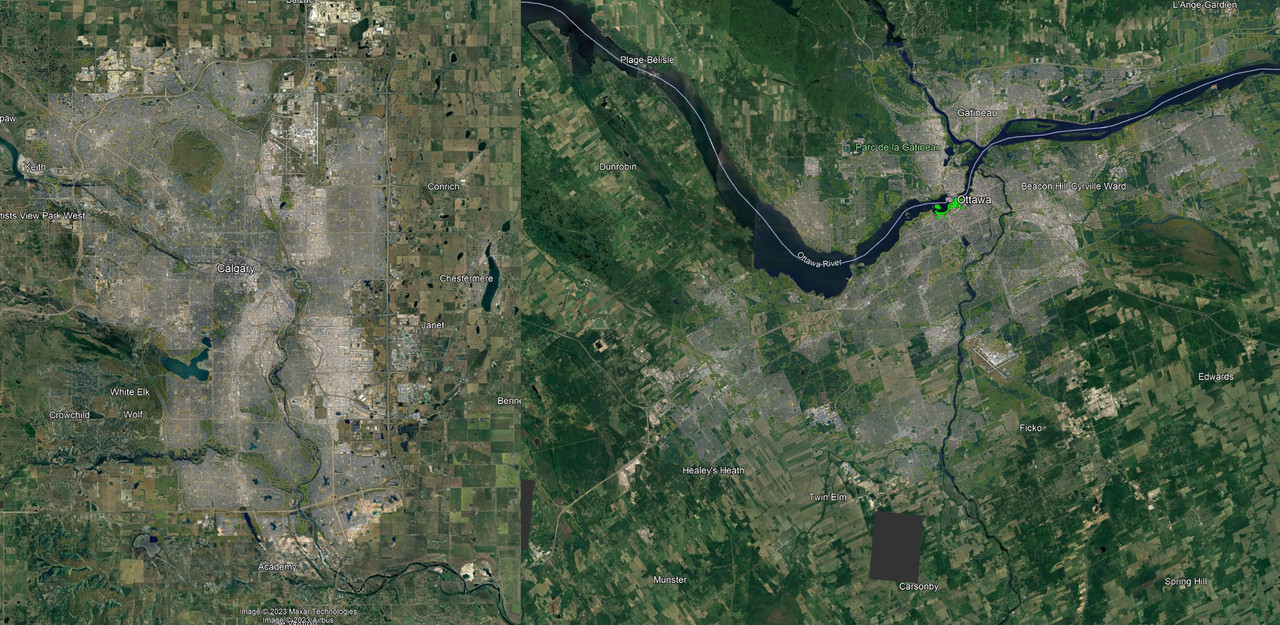
  #45  
Old Posted Feb 19, 2010, 11:24 AM
Ottawan Ottawan is offline
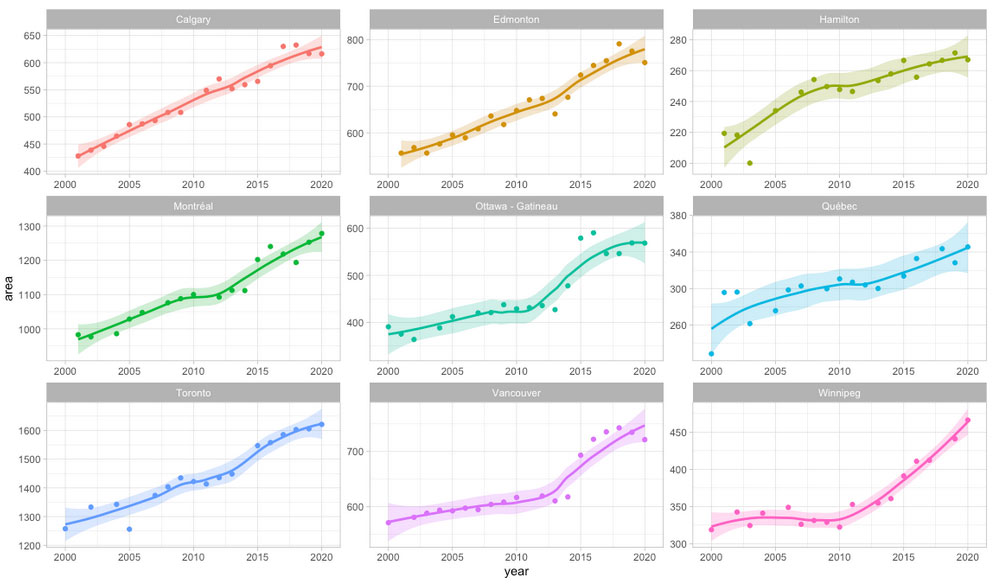
Citizen-at-large
 
Join Date: Aug 2009
Location: Expat (in Toronto)
Posts: 738
The 416 sign now says 900,000, although it's not a nice new sign like the one in the photo op at the start of this thread. The bright white of the '900' shows that this was a recent change.
Reply With Quote
     
     
  #46  
Old Posted Feb 19, 2010, 4:08 PM
Mille Sabords's Avatar
Mille Sabords Mille Sabords is offline
Elle est déjà vide!
 
Join Date: Sep 2006
Location: Big Bad Ottawa
Posts: 2,083
Same for the 417 sign coming in from Montreal. Those are MTO signs; the photo-op one that was in the paper was a City sign which goes up on City roads.
Reply With Quote
     
     
  #47  
Old Posted Feb 19, 2010, 6:13 PM
harls's Avatar
harls harls is offline
Mooderator
 
Join Date: Jan 2002
Location: Aylmer, Québec
Posts: 21,304
Reply With Quote
     
     
  #48  
Old Posted Apr 2, 2010, 4:17 PM
dennis1 dennis1 is offline
Registered User
 
Join Date: Sep 2007
Posts: 1,253
the Former city of Ottawa has a population of 391,860 according to this estimate.
Reply With Quote
     
     
  #49  
Old Posted Apr 29, 2023, 2:42 PM
Harley613's Avatar
Harley613 Harley613 is offline
Registered User
 
Join Date: Jun 2009
Location: Aylmer, QC
Posts: 6,878
Ottawa - Worst Suburban Sprawl in Canada

CBC has used AI to measure population density in Canada's major urban areas from 2001 to 2021, and guess which city wins the prize for the worst urban sprawl in Canada?

https://ici.radio-canada.ca/info/2022/03...nsport-commun-changements-climatiques/en

Montreal -9.7%
Toronto +1.9%
Calgary +3.3%
Edmonton +5%
Hamilton -11.2%
Ottawa-Gatineau -18.5%
Quebec -1.7%
Vancouver -1.5%
Winnipeg -12.9%

Ottawa is far and away the least sustainable worst managed city in Canada. A National embarrassment in the era of rapid climate change. We are doing the least to prepare for the future, and it's sad. Million dollar cookie cutter townhomes in tracts extending to the horizon is what we want and it's what we continue to get.
__________________
Instagram: https://www.instagram.com/the.harleydavis/
Reply With Quote
     
     
  #50  
Old Posted Apr 29, 2023, 4:05 PM
vtecyo vtecyo is offline
Registered User
 
Join Date: Feb 2015
Posts: 328
Quote:
Originally Posted by Harley613 View Post
CBC has used AI to measure population density in Canada's major urban areas from 2001 to 2021, and guess which city wins the prize for the worst urban sprawl in Canada?

https://ici.radio-canada.ca/info/2022/03...nsport-commun-changements-climatiques/en

Montreal -9.7%
Toronto +1.9%
Calgary +3.3%
Edmonton +5%
Hamilton -11.2%
Ottawa-Gatineau -18.5%
Quebec -1.7%
Vancouver -1.5%
Winnipeg -12.9%

Ottawa is far and away the least sustainable worst managed city in Canada. A National embarrassment in the era of rapid climate change. We are doing the least to prepare for the future, and it's sad. Million dollar cookie cutter townhomes in tracts extending to the horizon is what we want and it's what we continue to get.
Ouch... I knew the growth of the suburbs was significant - but dude...

BTW - that website is super-slick, I love the use of 3d map/chart/things.
Reply With Quote
     
     
  #51  
Old Posted Apr 29, 2023, 6:07 PM
Harley613's Avatar
Harley613 Harley613 is offline
Registered User
 
Join Date: Jun 2009
Location: Aylmer, QC
Posts: 6,878
Mods can we change my thread title to worst SUBURBAN sprawl in Canada?

__________________
Instagram: https://www.instagram.com/the.harleydavis/
Reply With Quote
     
     
  #52  
Old Posted Apr 29, 2023, 6:15 PM
rocketphish's Avatar
rocketphish rocketphish is online now
Planet Ottawa and beyond
 
Join Date: Feb 2009
Location: Greater Ottawa
Posts: 14,461
Quote:
Originally Posted by harley613 View Post
mods can we change my thread title to worst suburban sprawl in canada?

Reply With Quote
     
     
  #53  
Old Posted Apr 30, 2023, 3:30 AM
Nowhere Nowhere is offline
Registered User
 
Join Date: May 2018
Posts: 228
I'm surprised to see that the population density increased in Calgary. They seem to have a lot of sprawl similar to Ottawa.
Reply With Quote
     
     
  #54  
Old Posted Apr 30, 2023, 2:29 PM
YOWetal YOWetal is offline
Registered User
 
Join Date: Oct 2006
Posts: 7,577
Quote:
Originally Posted by Nowhere View Post
I'm surprised to see that the population density increased in Calgary. They seem to have a lot of sprawl similar to Ottawa.
I think some of this is how large the city limits are. Edmonton and Ottawa are both very large so most of the sprawl counts against them. Toronto much of it is outside the GTA. Hamilton almost all of it is.
Reply With Quote
     
     
  #55  
Old Posted Apr 30, 2023, 6:20 PM
Nowhere Nowhere is offline
Registered User
 
Join Date: May 2018
Posts: 228
Quote:
Originally Posted by YOWetal View Post
I think some of this is how large the city limits are. Edmonton and Ottawa are both very large so most of the sprawl counts against them. Toronto much of it is outside the GTA. Hamilton almost all of it is.
They were looking at the urban areas, not within the city limits, so there must be another explanation.
Reply With Quote
     
     
  #56  
Old Posted Apr 30, 2023, 6:45 PM
Harley613's Avatar
Harley613 Harley613 is offline
Registered User
 
Join Date: Jun 2009
Location: Aylmer, QC
Posts: 6,878
If you look at Ottawa and Calgary side by side at the same scale, the difference is jarring. Calgary is so dense and contained within or close by it's ring road. Ottawa looks like a random paint accident with very little sense to it's sprawl. The furthest you can walk in one direction and still be within the urban agglomeration is 9 kilometers less in Calgary than in Ottawa, and in Ottawa that extra 9kms is unserviced greenbelt land that we are extending our utilities across.

__________________
Instagram: https://www.instagram.com/the.harleydavis/
Reply With Quote
     
     
  #57  
Old Posted Apr 30, 2023, 7:34 PM
m0nkyman m0nkyman is offline
Registered User
 
Join Date: Oct 2006
Location: Ottawa
Posts: 2,032
How dismal.
__________________
--Between build-and-run developers, budget-conscious planning departments, reactionary community associations and their city councillors, and the unaccountable OMB, we have more than enough bad actors sharing more than enough pathologies and perverse incentives.-David Reevely--
Reply With Quote
     
     
  #58  
Old Posted Apr 30, 2023, 8:47 PM
J.OT13's Avatar
J.OT13 J.OT13 is offline
Moderator
 
Join Date: Mar 2012
Location: Ottawa
Posts: 28,396
Quote:
Originally Posted by Harley613 View Post
If you look at Ottawa and Calgary side by side at the same scale, the difference is jarring. Calgary is so dense and contained within or close by it's ring road. Ottawa looks like a random paint accident with very little sense to it's sprawl. The furthest you can walk in one direction and still be within the urban agglomeration is 9 kilometers less in Calgary than in Ottawa, and in Ottawa that extra 9kms is unserviced greenbelt land that we are extending our utilities across.
The Greenbelt is what kills us when it comes to lack of density, for better or worse. That, and the ridiculous expanse of land, thanks to Mike Harris. Gatineau has some huge gaps as well, with Golf Clubs in the west and nothingness between the airport and Anger, followed by another stretch of nothing to Masson and Buckingham.

That said, the inner Greenbelt to me seems far denser than Calgary or Edmonton. Clusters of towers in quite a few spots. The "urban" downtown neighbourhoods stretch further as well, roughly 13kmx6km, while Calgary, there isn't much outside Downtown and the Beltline (3kmx2km) and Edmonton, a bit more expansive than Calgary (maybe 4kmx3km).

Full disclosure, I've never been to Calgary or Edmonton, but they do seem more like American Cities, with a tower cluster Downtown and a sudden drop to single family outside the core. But yes, they are far more compact as they don't have Greenbelts and they've grown by annexing areas outside town bit by bit instead of amalgamating with rural counties far and wide, which encouraged further sprawl in Ottawa (and Gatineau).
Reply With Quote
     
     
  #59  
Old Posted Apr 30, 2023, 9:10 PM
Richard Eade Richard Eade is offline
Registered User
 
Join Date: Mar 2008
Location: Nepean
Posts: 2,566
Yup, there are lots of ways to interpret statistics.

Just for fun, since the majority seem to be comparing Ottawa-Gatineau to Calgary, based on what the Radio-Canada site presents, I’ll give a different interpretation:

(All numbers that I use are from the data used in the Radio-Canada article, and can be found at https://ici.radio-canada.ca/info/codesource/code-ouvert/2022/03/etalement-urbain/analysis.nb.html)

In 2001, Calgary’s population was 977,810; its urban area was 427 km2; giving a density of 2,282 people per km2.
In 2001, Ottawa-Gatineau had 1,127,704 people; in an area of 380 km2; giving a density of 3,091 people per km2.

Based on that, I would say that Ottawa-Gatineau was winning the ‘density competition’ by a fair amount, in 2001.

Fast forward to 2021, and Calgary has increased its urban area by 201 km2, while Ottawa-Gatineau has only increased its urban area by 189 km2. So, Ottawa-Gatineau started smaller and increased by a smaller amount, compared to Calgary.

Well, why is Calgary being praised and Ottawa-Gatineau vilified? Because Calgary’s density increased, while Ottawa-Gatineau’s dropped.

How can that be, if Ottawa-Gatineau increased their urban area by a smaller amount? Because more people mover to Calgary than to Ottawa-Gatineau – a lot more people. Calgary’s population increased by 504,698, while Ottawa-Gatineau’s population grew by 306,644. Thus, Calgary was fortunate enough to have enough new people come there to compensate for the large growth in its urban area.

It turned out that there was something of an ‘oil boom’ during recent times. That puts money into Alberta, which attracts people. Looking at the population growth numbers: Calgary and Edmonton grew by about 50%, having the highest draw (petroleum money); Vancouver, Toronto and Ottawa-Gatineau by about 27%, being quite desirable places; ‘Winter’peg, being less desirable, grew by only 19%; then there were the two Quebec-based cities, Montreal and Quebec City, which only grew by about 18% (perhaps because of the language issue); Hamilton was at the bottom of the growth list at 14% (but, having visited Hamilton, I can understand why).

I have sometimes heard people proclaim that “numbers don’t lie.” But, sometimes, they don’t tell the whole story, either. There are usually reasons behind the numbers.

Oh, and the urban density competition, even after Calgary’s gain and Ottawa-Gatineau’s decline, still goes to Ottawa-Gatineau, with a 2021 density of 2,520, over Calgary’s 2,358 people per km2.

Oh, and if you go to the website listed above, you can find interesting phenomenon; like the sudden increase in Ottawa-Gatineau’s urban size when Watson became mayor. (I will leave you to decide if it was payback for help getting elected. It may not be, since there were several cities that increased the rate of urban expansion around the same time.)
Reply With Quote
     
     
  #60  
Old Posted Apr 30, 2023, 9:47 PM
Williamoforange's Avatar
Williamoforange Williamoforange is offline
Registered User
 
Join Date: Sep 2020
Location: Ottawa
Posts: 855
Quote:
Originally Posted by Richard Eade View Post
Yup, there are lots of ways to interpret statistics.

Just for fun, since the majority seem to be comparing Ottawa-Gatineau to Calgary, based on what the Radio-Canada site presents, I’ll give a different interpretation:

(All numbers that I use are from the data used in the Radio-Canada article, and can be found at https://ici.radio-canada.ca/info/codesource/code-ouvert/2022/03/etalement-urbain/analysis.nb.html)

In 2001, Calgary’s population was 977,810; its urban area was 427 km2; giving a density of 2,282 people per km2.
In 2001, Ottawa-Gatineau had 1,127,704 people; in an area of 380 km2; giving a density of 3,091 people per km2.

Based on that, I would say that Ottawa-Gatineau was winning the ‘density competition’ by a fair amount, in 2001.

Fast forward to 2021, and Calgary has increased its urban area by 201 km2, while Ottawa-Gatineau has only increased its urban area by 189 km2. So, Ottawa-Gatineau started smaller and increased by a smaller amount, compared to Calgary.

Well, why is Calgary being praised and Ottawa-Gatineau vilified? Because Calgary’s density increased, while Ottawa-Gatineau’s dropped.

How can that be, if Ottawa-Gatineau increased their urban area by a smaller amount? Because more people mover to Calgary than to Ottawa-Gatineau – a lot more people. Calgary’s population increased by 504,698, while Ottawa-Gatineau’s population grew by 306,644. Thus, Calgary was fortunate enough to have enough new people come there to compensate for the large growth in its urban area.

It turned out that there was something of an ‘oil boom’ during recent times. That puts money into Alberta, which attracts people. Looking at the population growth numbers: Calgary and Edmonton grew by about 50%, having the highest draw (petroleum money); Vancouver, Toronto and Ottawa-Gatineau by about 27%, being quite desirable places; ‘Winter’peg, being less desirable, grew by only 19%; then there were the two Quebec-based cities, Montreal and Quebec City, which only grew by about 18% (perhaps because of the language issue); Hamilton was at the bottom of the growth list at 14% (but, having visited Hamilton, I can understand why).

I have sometimes heard people proclaim that “numbers don’t lie.” But, sometimes, they don’t tell the whole story, either. There are usually reasons behind the numbers.

Oh, and the urban density competition, even after Calgary’s gain and Ottawa-Gatineau’s decline, still goes to Ottawa-Gatineau, with a 2021 density of 2,520, over Calgary’s 2,358 people per km2.

Oh, and if you go to the website listed above, you can find interesting phenomenon; like the sudden increase in Ottawa-Gatineau’s urban size when Watson became mayor. (I will leave you to decide if it was payback for help getting elected. It may not be, since there were several cities that increased the rate of urban expansion around the same time.)
Ottawa lost a court case around 2011 when they tried to not expand the urban boundary. So no nothing untowards done by a mayor....and its incredibly ... to even attempt to imply as much....

https://www.cbc.ca/news/canada/ottawa/ottawa-boundaries-expansion-ordered-1.976213
Reply With Quote
     
     
This discussion thread continues

Use the page links to the lower-right to go to the next page for additional posts
 
 
Reply

Go Back   SkyscraperPage Forum > Regional Sections > Canada > Ontario > Ottawa-Gatineau > Urban, Urban Design & Heritage Issues
Forum Jump


Forum Jump


All times are GMT. The time now is 11:40 PM.

     
SkyscraperPage.com - Privacy Statement - Top

Powered by vBulletin® Version 3.8.7
Copyright ©2000 - 2026, vBulletin Solutions, Inc.