HomeDiagramsDatabaseMapsForum About
     

Go Back   SkyscraperPage Forum > Regional Sections > Canada


Reply

 
Thread Tools Display Modes
     
     
  #41  
Old Posted Feb 6, 2018, 1:42 AM
Laceoflight's Avatar
Laceoflight Laceoflight is offline
Montérégien
 
Join Date: Nov 2014
Location: Montréal, QC <> Paris, FR
Posts: 1,242
Quote:
Originally Posted by GreaterMontréal View Post
Joliette n'est pas plutôt une AR ?
Oui, excuse-moi, j'ai produit ces cartes rapidement sur le bord du bureau...
Reply With Quote
     
     
  #42  
Old Posted Feb 6, 2018, 1:43 AM
GreaterMontréal's Avatar
GreaterMontréal GreaterMontréal is offline
Registered User
 
Join Date: Dec 2013
Posts: 4,628
Quote:
Originally Posted by Laceoflight View Post
Only 9,3% of St-Hyacinthe workforce commutes to the Montreal population centre. The situation is about the same in Sorel-Tracy (9,8%), Joliette (10,7%).

Lachute is at 19,3%, Saint-Jean-sur-Richelieu 33,9%, Valleyfield 38,3% and Saint-Jérôme 43,6%...
la MRC de Joliette est à 67,000 , en hausse de 3,500 depuis 2011. +9%

Lachute c'est pas la porte lol la ville était sous les 9% en 2011, maintenant 20% !!!
Quote:
Oui, excuse-moi, j'ai produit ces cartes rapidement sur le bord du bureau...
pas de trouble, merci de prendre le temps.

Last edited by GreaterMontréal; Feb 6, 2018 at 1:56 AM.
Reply With Quote
     
     
  #43  
Old Posted Feb 6, 2018, 2:09 AM
Laceoflight's Avatar
Laceoflight Laceoflight is offline
Montérégien
 
Join Date: Nov 2014
Location: Montréal, QC <> Paris, FR
Posts: 1,242
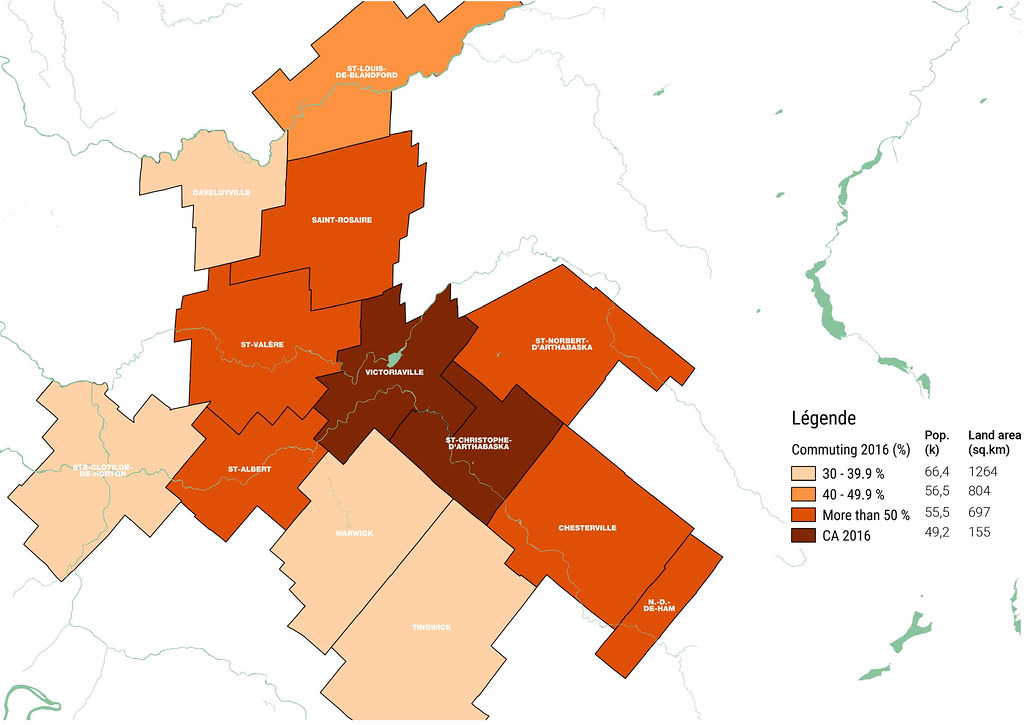
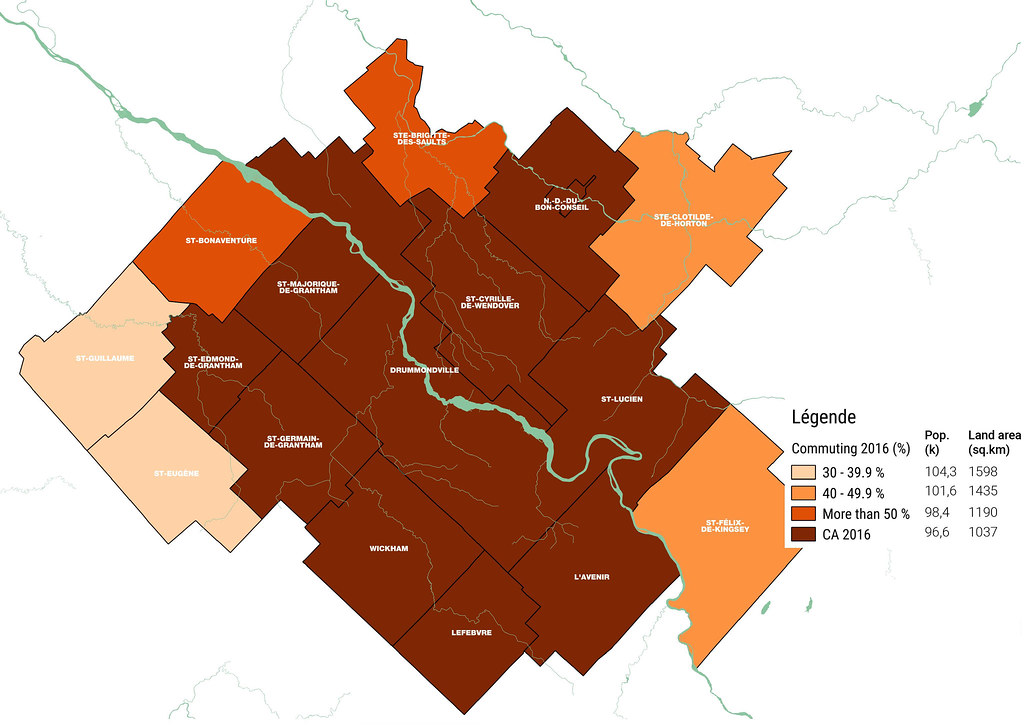
Voilà tes cartes :

Victoriaville


Drummondville
Reply With Quote
     
     
  #44  
Old Posted Feb 6, 2018, 2:13 AM
GreaterMontréal's Avatar
GreaterMontréal GreaterMontréal is offline
Registered User
 
Join Date: Dec 2013
Posts: 4,628
Quote:
Originally Posted by Laceoflight View Post
Voilà tes cartes :

Victoriaville


Drummondville
oh nice, on voit bien que Drummondville a tout avalé les villes autour. je me demande pourquoi on ne voit pas la même chose pour Joliette et Victoriaville, Princeville (MRC Érable) doit aussi avoir un bon taux de navettage vers Victo.

Last edited by GreaterMontréal; Feb 6, 2018 at 2:27 AM.
Reply With Quote
     
     
  #45  
Old Posted Feb 6, 2018, 10:41 PM
Dirt_Devil's Avatar
Dirt_Devil Dirt_Devil is offline
Registered User
 
Join Date: May 2003
Location: Quebec City
Posts: 901
Quote:
Originally Posted by Laceoflight View Post
In Québec, there are also a number of communities that reach the first criterium of inclusion into the CMA (50% commuting) without being included, many of them since more than 1 census. They account for ~38k people.

More than 50% commuting (2016) :
South Shore, population 19023
  • Saint-Apollinaire _ 62,8
  • Saint-Agapit _ 52,2
  • Saint-Gilles _ 55,9
  • Saint-Charles-de-Bellechasse _ 55,5
  • La Durantaye _ 55,1
  • Saint-Michel-de-Bellechasse _ 50,4
  • Saint-Vallier _ 61,3

North Shore, population 19053
  • Pont-Rouge _ 51,2
  • Sainte-Anne-de-Beaupré and Beaupré _ 52,1
  • Saint-Férréol-les-Neiges _ 60,4


A small number of municipalities also have a commuting flow of between 40 and 50% :

South Shore
  • Dosquet _ 40,8
  • Issoudun _ 41,2

North Shore
  • Donnacona and Cap-Santé _ 45,3
  • Saint-Joachim _ 44,6
As-tu une map pour la RMR de Québec comme tu as pour Montréal, Drummondville et autres?

D'ailleurs, on voit que Drummondville sera une RMR sous peu avec ses 105 000 habitants sur 1600 km2. De plus, Montréal attire du monde qui habite loin en maudit!
__________________
- La blonde dit: regarde Jean comme ces chevals sont beaux!

- Jean: Mais voyons ce ne sont pas des chevals, ce sont des chevaux

- La blonde: ahhh bon!...pourtant sa ressemblait a des chevals
Reply With Quote
     
     
  #46  
Old Posted Feb 7, 2018, 12:06 AM
Laceoflight's Avatar
Laceoflight Laceoflight is offline
Montérégien
 
Join Date: Nov 2014
Location: Montréal, QC <> Paris, FR
Posts: 1,242
Quote:
Originally Posted by Dirt_Devil View Post
As-tu une map pour la RMR de Québec comme tu as pour Montréal, Drummondville et autres?

D'ailleurs, on voit que Drummondville sera une RMR sous peu avec ses 105 000 habitants sur 1600 km2. De plus, Montréal attire du monde qui habite loin en maudit!
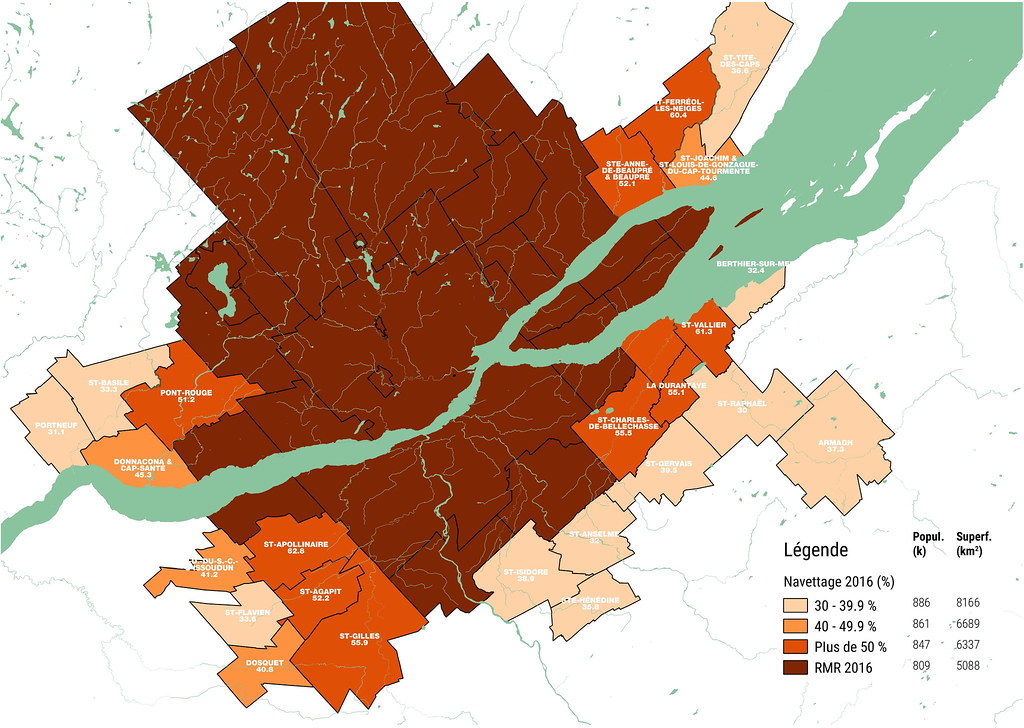
Voici Québec.
Si tu te demandes, Saint-Raymond est à 27,4 %.
Les populations utilisées sont les dernières de l'ISQ pour juillet 2016.

Reply With Quote
     
     
  #47  
Old Posted Feb 7, 2018, 9:41 PM
Dirt_Devil's Avatar
Dirt_Devil Dirt_Devil is offline
Registered User
 
Join Date: May 2003
Location: Quebec City
Posts: 901
^^

Un gros merci!! ces cartes sont très utiles....!

Petite question, tu as listé la CMA de Québec à 5088 km2 alors que StatCan la met à environ 3408 km2?

Avec ta carte, on constate que la région immédiate de Québec fait au moins 900,000 habitants selon le "commuting pattern''. De plus, faut pas oublier que toute la région au nord de la CMA n'est pratiquement pas habitée donc ça tire la densité totale à la baisse.
__________________
- La blonde dit: regarde Jean comme ces chevals sont beaux!

- Jean: Mais voyons ce ne sont pas des chevals, ce sont des chevaux

- La blonde: ahhh bon!...pourtant sa ressemblait a des chevals
Reply With Quote
     
     
  #48  
Old Posted Mar 4, 2018, 6:27 AM
GreaterMontréal's Avatar
GreaterMontréal GreaterMontréal is offline
Registered User
 
Join Date: Dec 2013
Posts: 4,628
Quote:
A CA adjacent to a CMA can be merged with the CMA if the total percentage commuting interchange between the CA and CMA is equal to at least 35% of the employed labour force living in the CA, based on place of work data from the previous census.
Joliette to Montréal : 2,950
Montréal to Joliette : 3,665
population active +- 25k , navettage 2 sens, environ 25%
was 15.7% in 2011, an increase of 10% in just 5 years !!

Valleyfield to Montréal : 5,130
Montréal to Valleyfield : 4,360
population active, +-20k , navettage 2 sens, environ 50%.

Lachute to Montréal : 1,340
Montréal to Lachute : 1,210
population active +- 6k , navettage 2 sens , environ 40%


So we would have 3 other CAs that could merge with Montreal. Valleyfield and Lachute would be next in 2021, and probably Joliette in 2026.

Saint-Hyacinthe (CA) is not adjacent to Montreal mais le navettage entre les 2 is about 35%. The CA is +-8 km from the Montréal CMA limit.


Last edited by GreaterMontréal; Mar 4, 2018 at 8:35 AM.
Reply With Quote
     
     
  #49  
Old Posted Mar 10, 2018, 3:53 AM
Docere Docere is offline
Registered User
 
Join Date: Jul 2014
Posts: 8,811
Erin, Wellington County is very integrated into the GTA commuting-wise.

62% work in the GTA, a majority in Peel/Halton (53%).

A sizable 29.3% in Guelph/Eramosa Township work in the GTA as well, but just 8.7% in Centre Wellington.
Reply With Quote
     
     
  #50  
Old Posted Mar 10, 2018, 4:34 AM
Docere Docere is offline
Registered User
 
Join Date: Jul 2014
Posts: 8,811
In South Simcoe County, 41.6% commute to the GTA. This includes 53.3% in Bradford-West Gwillimbury, 44.4% in New Tecumseth, 43% in Innisfil, 40.7% in Adjala-Tosorontio and 16.4% in Essa Township.
Reply With Quote
     
     
  #51  
Old Posted Mar 10, 2018, 3:24 PM
megadude megadude is offline
Registered User
 
Join Date: Sep 2017
Location: N. York/Bram/Mark/Sauga/Burl/Oak/DT
Posts: 3,659
I suppose those numbers aren't all that surprising given that they border the GTA. I suppose several years ago those numbers would be smaller with significantly more commuting to Guelph or Barrie instead of GTA. But home prices continue to push people out.

As well, I think as places like Brampton and Mississauga get more and more congested, people, particularly white people, migrate outwards to places where they can own a house that is separated from your neighbour by more than five feet.

Not that long ago I noticed home prices in rural Burlington or Milton were actually affordable. Now they are priced higher than one would think. These homes are inconveniently farther from work, school and shopping, yet there is a premium for having a lot with trees that's bigger than a postage stamp.

In places like Erin, Alliston, Beeton, Rockwood, etc., decent homes are obviously not as highly priced as Milton and Burlington Escarpment, or say Nobleton or Schomberg areas of King Township, but they aren't exactly cheap.

My neighbour from when I was growing up in Brampton still lives there. He works not even a 15 minute drive away in Brampton. But he seriously considered moving to Rockwood as his two kids left the nest. His house, like the one I grew up in, is on a hill with a high up deck and backs onto a forest. So it's not the super high density subdivisions you see now. But he still kind of wanted the country experience. But is that worth it to more than triple his commute? That's the ultimate question.

One of our clients at work lives in basically a mansion in Erin on a big lot. He worked in NW Sauga. He ran a company and owned the building as well. Company has done real well. He wasn't super rich but definitely well off (saw his net worth statement during the underwriting for the mortgage). His kind of house in Erin would be found in Sauga somewhere off Mississauga Road. Houses of that size there would be at least double if not triple in price I would imagine.

However, last year he sold the company and the building for several millions. He could live wherever he wants now. Though I would imagine he stayed in Erin since he gives off that small town vibe. I too would rather have a mansion with space around instead of surrounded by other houses.
Reply With Quote
     
     
  #52  
Old Posted Jun 30, 2026, 7:29 PM
Docere Docere is offline
Registered User
 
Join Date: Jul 2014
Posts: 8,811
Smaller CMAs commuting data from 2021 census (Oshawa, Barrie and Hamilton to Toronto and Abbotsford-Mission to Vancouver).

Oshawa CMA

Work in Oshawa 24.7%
Work in Whitby 20.1%
Commute to Toronto CMA 38.2%
Commute to Toronto CMA and outside Durham Region 26.3%
Commute to City of Toronto 18.4%

Whitby

Work in Whitby 33%
Commute to Oshawa 10.6%
Commute to Toronto CMA 50.5%
Commute to Toronto CMA and outside Durham Region 36.2%
Commute to City of Toronto 25.3%

Oshawa

Work in Oshawa 38.8%
Commute to Whitby 15.9%
Commute to Toronto CMA 35.5%
Commute to Toronto CMA and outside Durham Region 24.4%
Commute to City of Toronto 16.9%

Clarington

Work in Clarington 34.7%
Commute to Oshawa 19.8%
Commute to Toronto CMA 27.4%
Commute to Toronto CMA and outside Durham Region 17.6%
Commute to City of Toronto 12.6%

Barrie CMA

Work in Barrie 52.2%
Commute to Toronto CMA 27.3%
Commute to Toronto CMA and outside Simcoe County 19.4%
Commute to City of Toronto 5.9%

Innisfil

Work in Innisfil 24.7%
Commute to Barrie 22.3%
Commute to Toronto CMA 46.9%
Commute to Toronto CMA and outside Simcoe County 35.7%
Commute to City of Toronto 9.2%

Barrie

Work in Barrie 62%
Commute to Toronto CMA 23.7%
Commute to Toronto CMA and outside Simcoe County 16.3%
Commute to City of Toronto 5.5%

Springwater

Work in Springwater 21.5%
Commute to Barrie 41.6%
Commute to Toronto CMA 15.8%
Commute to Toronto CMA and outside Simcoe County 10.2%
Commute to City of Toronto 2.8%

Hamilton CMA

Work in Hamilton 55%
Work in Burlington 19.7%
Commute to Toronto CMA 17%
Commute to Oakville 5.8%
Commute to Mississauga 4.5%
Commute to City of Toronto 3.6%

Burlington

Work in Burlington 50.5%
Commute to Hamilton 10.8%
Commute to Toronto CMA 34.5%
Commute to Oakville 13.6%
Commute to Toronto CMA and outside Halton Region 16.6%
Commute to Mississauga 8.8%
Commute to City of Toronto 6.7%


Hamilton

Work in Hamilton 69.8%
Commute to Burlington 10.9%
Commute to Toronto CMA 11.8%
Commute to Oakville 3.5%
Commute to Mississauga 3.2%
Commute to City of Toronto 2.7%

Grimsby

Work in Grimsby 28%
Commute to Hamilton 29.7%
Commute to Burlington 7.7%
Commute to Toronto CMA 13%
Commute to Oakville 4.4%
Commute to Mississauga 3.7%
Commute to City of Toronto 2.6%

Abbotsford-Mission CMA

Work in Abbotsford 55.3%
Commute to Metro Vancouver 29.1%

Abbotsford

Work in Abbotsford 64.2%
Commute to Metro Van 26.7%
Commute to Langley 12.7%
Commute to Surrey 6.4%

Mission

Work in Mission 36.1%
Commute to Abbotsford 21.9%
Commute to Metro Vancouver 38.2%
Commute to Maple Ridge 8.6%
Commute to Langley 8%
Commute to Surrey 6.7%
Reply With Quote
     
     
  #53  
Old Posted Jun 30, 2026, 7:48 PM
Docere Docere is offline
Registered User
 
Join Date: Jul 2014
Posts: 8,811
Smaller CMAs can't be dissolved into larger ones, but if the "35% rule" applied Oshawa would be joined with Toronto. More people in the Oshawa CMA commute to the Toronto CMA than to the "central city" of Oshawa. A majority of Whitby's workforce commuted to the Toronto CMA in 2021, and more Whitby residents commuted to the City of Toronto than to Oshawa. Even among Oshawa residents nearly as many commute to the Toronto CMA as work in Oshawa.
Reply With Quote
     
     
  #54  
Old Posted Jun 30, 2026, 9:27 PM
Architype's Avatar
Architype Architype is offline
♒︎ verified human
 
Join Date: Mar 2004
Location: 🍁 Canada
Posts: 14,030
^ You have them listed separately, but Langley, Surrey, and Maple Ridge, are a part of Metro Vancouver (CMA), so would that make the total 45.8% for Abbotsford? Mission is part of Abbotsford CMA.
Reply With Quote
     
     
  #55  
Old Posted Jun 30, 2026, 10:40 PM
Docere Docere is offline
Registered User
 
Join Date: Jul 2014
Posts: 8,811
They're included in the Metro Van numbers. I wanted to see what was "just beyond the line" so I included figures for Toronto CMA outside Durham, Simcoe, Halton etc. All of Metro Van is one census division, so I decided to look at a few municipalities as well.
Reply With Quote
     
     
End
 
 
Reply

Go Back   SkyscraperPage Forum > Regional Sections > Canada
Forum Jump


Forum Jump


All times are GMT. The time now is 12:43 PM.

     
SkyscraperPage.com - Privacy Statement - Top

Powered by vBulletin® Version 3.8.7
Copyright ©2000 - 2026, vBulletin Solutions, Inc.