A while ago (mid-May, I think), OC Transpo released a Customer First Action Plan – what Mayor Sutcliffe took pride in presenting as Ottawa’s 10-Point Plan for Better Transit. (It’s nice, for him, that he gets to present such improvement plans in competition against those who have registered for the Mayoral election. There should be a ‘Lame-Mayor’ rule that starts with the opening of the election campaign.)
How reasonable is that plan?
First, here is The 10-Point Plan:
Make Service Reliable- Restore Line 1 capacity by mid-June
- Improve Maintenance to be 80% Preventative
- Make bus schedules realistic
- Make Para Transpo more ‘on-demand’
Put Customers First- Build the most customer-focused service in Canada
- Host customer townhalls
- Have Special Constables mingle with the public
- Clean up Rideau Station
- Communicate more regularly and effectively with the public
- Introduce new KPIs
Strengthen Financial Stability- Upload LRT to Province
- Use advertising for revenue
- Develop a 10-year Capital Investment Plan
Build a Sustainable Work Force- Make OC Transpo the top transit employer in Canada
- Hire 20 more mechanics
- Listen to employee feedback to improve transit
The first thing that struck me is that there are 16 points in their 10-Point Plan. So, right off the bat, things are not adding up. Anyway . . .
I think that most of these points – regardless of how many there actually are – are really just words that sound good. The devil will be in the details. For example, one goal is to restore Line 1 to capacity. Great. Maybe we can finally get what we paid for? But, maybe not, if making all of the trains 2-cars long means reducing the frequency again – because of ‘Capacity Planning’. Notice that none of the points specifically mentions building up ridership. That MIGHT happen over time, IF they are successful in improving service, but increased ridership, itself, is not a goal. Thus, Capacity Planning says that 2-car trains can run at half the frequency of single cars. Getting 2-car trains back may not be an improvement.
The inrush of e-buses should go a long way to helping shift maintenance work from being 49% corrective (fixing the broken and worn-out parts of older buses) to being 80% preventative maintenance. Keeping newer buses in a state of good repair should be a better use of time than trying to put old buses that are past their expected service life back on the road after something breaks. There is a place for old, nostalgic, buses, but it is as advertising and charters, generating additional cash – see point 12. (Maybe OC Transpo can actually make use of its historical fleet?)
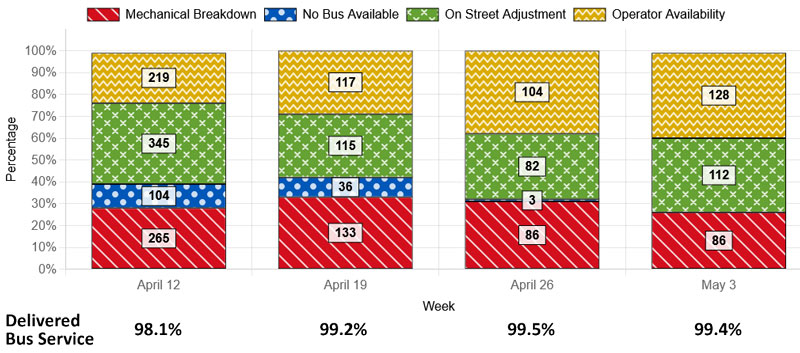
Another example of Devilish Details is point 3, making the schedules actually match the road conditions that the buses have to endure. That is, if road congestion routinely slows buses to the point that runs are canceled (On Street Adjustments, as OC Transpo calls them) then the schedule is not realistic. However, drawing up a realistic schedule, that takes into account slow bus movement, will, likely, require additional buses to be deployed to maintain the frequency. More buses means more bus operators, and more cost. Without an increase in both the Capital Budget (buying additional buses) and the Operating Budget (for more drivers and fuel) adjusting schedules to reflect longer run times translates to a reduction in service. Yes, customers will be able to have more faith in when their bus comes, but there will be fewer buses coming.
I think that it will be great IF OC Transpo can actually get the Special Constable to spend time walking around OC Transpo properties, instead of spending so much time sitting in their isolating bubble of a car, waiting for a call. It could even be part of the goal to communicate better with customers. The Special Constable don’t need to only have an enforcement roll. They can also be ambassadors for OC Transpo.
I was amused by the goal to introduce new KPIs. Yes, that point came immediately after the one about communicating more effectively with the public. And, yes, the point uses an acronym that a large portion of the public will have no idea what it stands for. Great start, Guys.
Of course, for those in-the-know, a KPI is a Key Performance Indicator. OC Transpo keeps statistics on a large number of performance indicators. The biggest problem that I can see with adding new ones is that they will, likely, not be shared with the public any more than the existing ones are. There is no indication that the newly created KPIs will be made public. How about, instead of creating new KPIs, OC Transpo just becomes a paragon of transparency and provides access to all of the data that it already monitors? Nah. That would expose OC Transpo to too much criticism about its performance.
Of course, some of the points (maybe most of them) are things that should be done as a matter of course – like cleaning up Rideau Station (Why only that one? Maybe Mr. Leary should visit ALL of the OC Transpo stops and stations.), and listening to feed-back (from customers and employees). That makes these goals, effectively, simply to do their jobs.
However, a couple of their objectives seem purely aspirational. Does OC Transpo have a shot at becoming the most customer-focused service (not limited to just TRANSIT SERVICE, I notice) in Canada? Or the top transit employer in Canada? I think that if OC Transpo is really aiming for those heights, they will probably need to do more than just what should be routine.





 Prev
Prev






 Linear Mode
