Agreed, that two central platforms may have been able to be created, with the middle track being close enough to both platforms that it could open either the right or left doors, depending on how the trains were running. Such a configuration could have given the following:
During the weekday, daytime:
From Algonquin to Downtown – stay on the inbound Line 1 train;
From Algonquin to Moodie – alight Line 1 at east platform, cross the platform, wait on east platform for Line 3 train;
From Moodie to Downtown – stay on the inbound Line 3 train;
From Moodie to Algonquin – alight Line 3 at east platform, cross the platform, wait on east platform for Line 1 train;
From Downtown to Algonquin – stay on the outbound Line 1 train;
From Downtown to Moodie – stay on the outbound Line 3 train.
And on week-ends and late evenings:
From Algonquin to Downtown – stay on the inbound Line 1 train;
From Algonquin to Moodie – alight Line 1 at east platform, up/down to the west platform, and wait for Line 3 train;
From Moodie to Downtown – alight Line 3 at west platform, up/down to the east platform, and wait for Line 1 train;
From Moodie to Algonquin – alight Line 3 at west platform, cross platform, wait on west platform for Line 1 train;
From Downtown to Algonquin – stay on the outbound Line 1 train;
From Downtown to Moodie – alight Line 1 at west platform, cross platform, wait on west platform for Line 3 train.
So, the benefit would be that Moodie to Algonquin and Downtown to Moodie would be cross-platform maneuvers during week-ends and late evenings. Everything else would remain the same as the current design – which uses an outside platform for Line 3 during low volume times.
It is an improvement for customers, but it pushes the tracks further apart, meaning that the underpass of Carling would have had to be even wider, and more expensive.
That said, here are a few possible options that they may have looked at for the station and track layout:
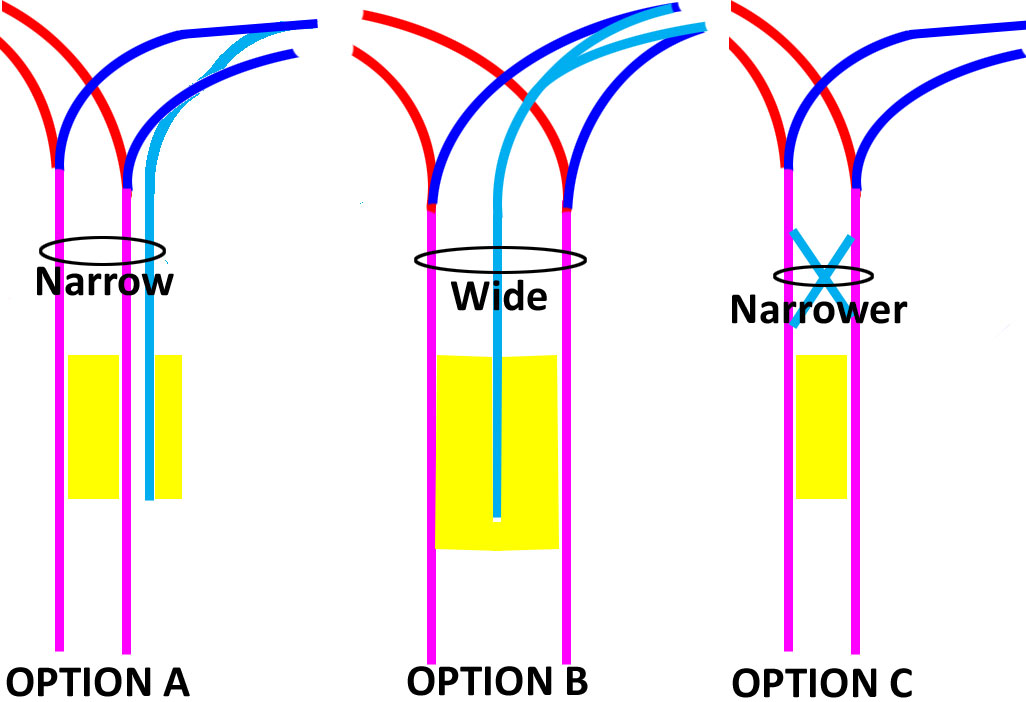
Option A was their choice. However, using the ‘2 Central Platforms’ idea, and realizing that the shortened Line 3 stopped at Lincoln Fields, Option B could have been chosen. In this depiction, the short-turned Line 3 enters a dead-end track so that the 2 central platforms can be joined. This arrangement allows for no need for ‘up and downs’ to move between platforms. Once people descend to the platform level from the bus level, they can go in any direction, at any time. This is the most convenient for changing trains – especially since the truncated Line 3 trains can be loaded in the pocket while Line 1 trains drop passengers. It is likely the most expensive option, however, and so unlikely to be chosen.
Option C is a minimal configuration, but it allows for only cross-platform transfers. In this option, Line 1 and Line 3 trains would need to be timed to arrive separately, but the truncated Line 3 trains could go to either side of the platform to accommodate Line 1 train arrivals. Variable signage would need to accurately display train movements.





 Prev
Prev






 Linear Mode
