HomeDiagramsDatabaseMapsForum About
     

Go Back   SkyscraperPage Forum > Discussion Forums > City Discussions


Reply

 
Thread Tools Display Modes
     
     
  #41  
Old Posted Sep 30, 2024, 6:15 PM
Emprise du Lion Emprise du Lion is offline
Registered User
 
Join Date: Jul 2015
Location: Saint Louis
Posts: 356
Quote:
Originally Posted by iheartthed View Post
Do other cities have income taxes on suburban commuters?
Both St. Louis and Kansas City, MO have an earnings tax on residents and commuters who work in the cities. The 1% tax is St. Louis' largest single source of revenue, and it accounts for more than a third St. Louis' annual budget.
Reply With Quote
     
     
  #42  
Old Posted Sep 30, 2024, 8:58 PM
Centropolis's Avatar
Centropolis Centropolis is offline
disneypilled verhoevenist
 
Join Date: Nov 2009
Location: saint louis
Posts: 12,051
Quote:
Originally Posted by Emprise du Lion View Post
Both St. Louis and Kansas City, MO have an earnings tax on residents and commuters who work in the cities. The 1% tax is St. Louis' largest single source of revenue, and it accounts for more than a third St. Louis' annual budget.
I've lived in St. Louis City or KCMO for the vast majority of my adult life and never minded paying the earnings tax unless there was a hiccup actually paying it and I ended up in arrears (which happened). Now, it's worth mentioning that I've been a homeowner for the majority of that time as well - and the difference in property taxes between St. Louis City and St. Louis County has made my overall tax burden significantly higher in St. Louis County. The earnings tax is a pain in the ass for low income renters - but I don't think that factor keeps more middle class homeowners from living in St. Louis City. I think it may impact some business placement decisions, but again property taxes are lower (sometimes significantly less) in St. Louis City than St. Louis County.

Last edited by Centropolis; Sep 30, 2024 at 9:16 PM.
Reply With Quote
     
     
  #43  
Old Posted Sep 30, 2024, 9:12 PM
3rd&Brown 3rd&Brown is offline
Registered User
 
Join Date: Oct 2007
Posts: 2,994
Philly has a income tax on workers both resident and non-resident. I think the first is about 3.8% and the second is 3.2% the last time I checked.

IMO the impact is relatively muted though for a few reasons.
1. PA's (state) income taxes are very low (3.08%). It's the lowest income tax of any state that charges an income tax (if that makes sense). Basically, you have all the "no tax" states like TN, FL, WA...then PA. Thus, generally paying PA state + Philly city you're still lower than NJ across the river and even the other surrounding states.
2. We're surrounded by higher tax states in every direction. PA's (state) income taxes pale in comparison to NJ, NY, MD, and even Delaware's. (Delaware is known as a "low tax" state, but its income taxes are actually very high).
3. Comparitively, Philadelphia has low property taxes (about 1% of market value). Again, far lower than surrounding states (exception Delaware) as well as PA's suburbs.
Reply With Quote
     
     
  #44  
Old Posted Oct 1, 2024, 2:43 AM
lio45 lio45 is offline
BANNED
 
Join Date: Aug 2007
Location: Quebec
Posts: 44,901
Quote:
Originally Posted by Centropolis View Post
The comparison is often made between Kansas City and Indianapolis - wondering how they compare apples to apples (other than KC has slightly better pre-war bones even though its 500 miles further west).
Speaking of KCMO, I recently came across this before/after scene that's apparently Kansas City, it's close to the worst destruction I've ever seen... I mean, I'd agree that it HAD good prewar bones. (Is the pic kinda out of context? Judging solely from it, looks like the scale of the destruction is somewhere between WWII Dresden and WWII Hiroshima, and much closer to the latter ...)

Reply With Quote
     
     
  #45  
Old Posted Oct 1, 2024, 6:22 AM
jmecklenborg jmecklenborg is offline
Registered User
 
Join Date: Jul 2003
Posts: 4,161
Quote:
Originally Posted by iheartthed View Post
That's a pretty terrible idea since every economy needs low wage workers, whether or not they directly show up in the bottom line of the tax coffers.
Supposedly most service workers commute to Monaco from France - probably the most extreme example of this dilemma.

But the whole issue with U.S. cities is that they really don't do much at all. Police, fire, maintain local roads...that's pretty much it. You might hear about other things a city is doing, but as a percentage of their budget, it's tiny. It's often the case that park boards and school boards and transit commissions and the sewer district and the waterworks are technically under the auspices of the city and those budgets can appear in the total city budget, but a mayor and city council usually has no say whatsoever in their budget or affairs. These procedural boundaries differ somewhat from state-to-state but there is almost no such thing as a truly strong mayor anywhere in the United States who lords over the parks, waterworks, airports, etc.


Quote:
Do other cities have income taxes on suburban commuters?
Yes. Ohio cities collect an earnings tax from *all* earnings in a city, irrespective of a worker's residence (even from those who commute into Ohio from bordering states). But this is currently being challenged as work-from-home people are trying to win an exemption.

The "low-tax" states like Tennessee that do not allow municipal earnings taxes make up for it with very high sales taxes (approaching 10% when combined with state/county). Nashville boosters like to cite "low taxes" for that city's boom while completely ignoring languishing Memphis, which enjoys the exact same tax environment.
Reply With Quote
     
     
  #46  
Old Posted Oct 1, 2024, 5:36 PM
Steely Dan's Avatar
Steely Dan Steely Dan is online now
devout Pizzatarian
 
Join Date: Jul 2001
Location: Lincoln Square, Chicago
Posts: 30,214
Quote:
Originally Posted by jmecklenborg View Post
^and residential population is basically irrelevant.
How is residential population an irrelevant stat?

It's by no means the only piece of the puzzle, but population decrease is one of the most readily available and clearest proxies that we have for American post-war urban decline.

Now, because household sizes have also been steadily declining over the same time period, I'm of the opinion that # of households is an even better measure, but historical data for that can be more cumbersome to find. And straight population hits pretty close to the same bullseye anyway, if you adjust for the roughly 30% decline in average household size over the last 70 years.
__________________
"Missing middle" housing can be a marvelous middle ground for many middle class families.

Last edited by Steely Dan; Oct 1, 2024 at 6:02 PM.
Reply With Quote
     
     
  #47  
Old Posted Oct 1, 2024, 7:02 PM
twinpeaks twinpeaks is offline
Registered User
 
Join Date: Nov 2006
Posts: 260
Quote:
Originally Posted by lio45 View Post
Speaking of KCMO, I recently came across this before/after scene that's apparently Kansas City, it's close to the worst destruction I've ever seen... I mean, I'd agree that it HAD good prewar bones. (Is the pic kinda out of context? Judging solely from it, looks like the scale of the destruction is somewhere between WWII Dresden and WWII Hiroshima, and much closer to the latter ...)

This is pretty sad. those were beautiful buildings
Reply With Quote
     
     
  #48  
Old Posted Oct 1, 2024, 8:11 PM
meh meh is offline
Registered User
 
Join Date: Dec 2023
Posts: 256
Reply With Quote
     
     
  #49  
Old Posted Oct 1, 2024, 8:22 PM
mrnyc mrnyc is offline
cle/west village/shaolin
 
Join Date: Jul 2006
Posts: 15,151
^ how very clevelandy. ugh.


Quote:
Originally Posted by jmecklenborg View Post
By contrast, the Cincinnati Public School District extends randomly outside the city limits of Cincinnati:

This stuff varies quite a bit from state-to-state. I have no idea what the laws are in Indiana.

The two islands inside the Cincinnati city limits are not Beverly Hills-type enclaves. They are all factory working class areas that the City of Cincinnati didn't get around to annexing before the state law changed in the 1920s and Cincinnati became landlocked by surrounding (and interior!) incorporated areas. Obviously, Columbus went on a postwar annexation spree, but that was of unincorporated territory.
columbus also has outside the city boundries schools along with inside the boundries suburban in the city schools, or bascially shared border areas (the agreement is called win-win). works for them.
Reply With Quote
     
     
  #50  
Old Posted Oct 2, 2024, 1:56 AM
Steely Dan's Avatar
Steely Dan Steely Dan is online now
devout Pizzatarian
 
Join Date: Jul 2001
Location: Lincoln Square, Chicago
Posts: 30,214
Quote:
Originally Posted by Steely Dan View Post

"Old City" Columbus (51 sq. miles):

1960 (peak): 389,222

2010 (nadir): 234,582

Change: -40%


Center Township, Indianapolis (42 sq. miles):

1950 (peak): 337,211

2010 (nadir): 142,787

Change: -58%

So, sticking with the whole "fixed geography of the urban core over time for Midwest post-war land annexers" theme, I calculated Milwaukee's 2020 population within its original 1950 city limits of 50 sq. miles (just prior to the city going on a mini-annexation binge of unincorporated county land in the '50s when Milwaukee nearly doubled in land area from 50 to 96 sq. miles).


"Old City" Milwaukee (50 sq. miles):

1950 (peak): 637,392

2020 (nadir): 418,206

Change: -34%


So "Old City" Milwaukee really isn't doing all that poorly when accounting for average household size shrinkage. And it's still roughly 2 - 2.5 times denser than the other two within these tighter geographies.
__________________
"Missing middle" housing can be a marvelous middle ground for many middle class families.

Last edited by Steely Dan; Oct 2, 2024 at 12:38 PM.
Reply With Quote
     
     
  #51  
Old Posted Oct 2, 2024, 3:06 AM
craigs's Avatar
craigs craigs is online now
Registered User
 
Join Date: May 2019
Location: Los Angeles
Posts: 10,695
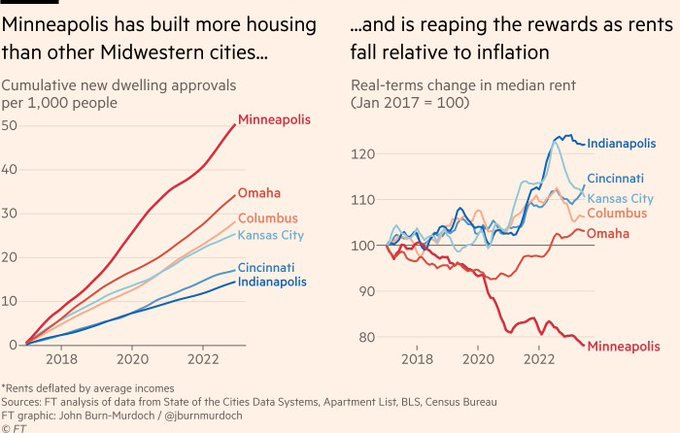
Interesting chart touching on the subject:

Reply With Quote
     
     
  #52  
Old Posted Oct 2, 2024, 2:14 PM
iheartthed iheartthed is online now
Registered User
 
Join Date: Oct 2009
Location: New York
Posts: 11,844
Quote:
Originally Posted by jmecklenborg View Post
Supposedly most service workers commute to Monaco from France - probably the most extreme example of this dilemma.
Monaco wouldn't be able to support itself if they didn't commute in from France. Monaco is smaller in area than New York's Central Park.

Quote:
Originally Posted by jmecklenborg View Post
But the whole issue with U.S. cities is that they really don't do much at all. Police, fire, maintain local roads...that's pretty much it. You might hear about other things a city is doing, but as a percentage of their budget, it's tiny. It's often the case that park boards and school boards and transit commissions and the sewer district and the waterworks are technically under the auspices of the city and those budgets can appear in the total city budget, but a mayor and city council usually has no say whatsoever in their budget or affairs. These procedural boundaries differ somewhat from state-to-state but there is almost no such thing as a truly strong mayor anywhere in the United States who lords over the parks, waterworks, airports, etc.
Most major cities maintain the water and sewage systems and the school systems. It was once common for cities to own and operate their transit systems too, but it became common in the postwar era for state governments to operate the transit agencies.
Reply With Quote
     
     
  #53  
Old Posted Oct 2, 2024, 3:55 PM
eschaton eschaton is offline
Registered User
 
Join Date: Dec 2013
Posts: 5,570
Quote:
Originally Posted by iheartthed View Post
Most major cities maintain the water and sewage systems and the school systems. It was once common for cities to own and operate their transit systems too, but it became common in the postwar era for state governments to operate the transit agencies.
Hell, I grew up in New England, where the cities/towns mostly controlled the schools directly (the idea of elected school boards was completely alien to me when I moved elsewhere, as was the idea of county government).

Or look at Virginia, where cities cannot be inside counties, and the powers of a city and county are identical.

Point being, you can't really generalize about what cities can/cannot do.
Reply With Quote
     
     
  #54  
Old Posted Oct 2, 2024, 6:17 PM
ColDayMan's Avatar
ColDayMan ColDayMan is offline
B!tchslapping Since 1998
 
Join Date: Jul 2001
Location: Columbus
Posts: 20,461
Quote:
Originally Posted by Steely Dan View Post
So, sticking with the whole "fixed geography of the urban core over time for Midwest post-war land annexers" theme, I calculated Milwaukee's 2020 population within its original 1950 city limits of 50 sq. miles (just prior to the city going on a mini-annexation binge of unincorporated county land in the '50s when Milwaukee nearly doubled in land area from 50 to 96 sq. miles).


"Old City" Milwaukee (50 sq. miles):

1950 (peak): 637,392

2020 (nadir): 418,206

Change: -34%


So "Old City" Milwaukee really isn't doing all that poorly when accounting for average household size shrinkage. And it's still roughly 2 - 2.5 times denser than the other two within these tighter geographies.
Just an FYI, I revised the Columbus old city square miles to 40 square miles in 1950 (per AllColumbusData) making it 6,423 per square mile in 2020. Milwaukee is still denser.
__________________
Click the x: _ _ X _ _!
Reply With Quote
     
     
  #55  
Old Posted Oct 2, 2024, 9:15 PM
Steely Dan's Avatar
Steely Dan Steely Dan is online now
devout Pizzatarian
 
Join Date: Jul 2001
Location: Lincoln Square, Chicago
Posts: 30,214
^ gotcha, thanks for the correction.

Updated:


"Old City" Milwaukee (50 sq. miles):

1950 (peak): 637,392 / 12,748 ppsm

2020 (nadir): 418,206 / 8,364 ppsm

Change: -34%


"Old City" Columbus (40 sq. miles):

1960 (peak): 389,222 / 9,731 ppsm

2010 (nadir): 234,582 / 5,865 ppsm

Change: -40%


Center Township, Indianapolis (42 sq. miles):

1950 (peak): 337,211 / 8,028 ppsm

2010 (nadir): 142,787 / 3,400 ppsm

Change: -58%


So those are 3 of the 4 major midwest central city post-war land-annexers, now controlled for a reasonable fixed geography.

if anyone is willing/able to tackle KC, please have it, but KC is likely to be the lowest on this score, considering how much land it grabbed (+290%), and how little its popularion has changed (+11%), since 1950.
__________________
"Missing middle" housing can be a marvelous middle ground for many middle class families.
Reply With Quote
     
     
  #56  
Old Posted May 13, 2026, 1:40 AM
Steely Dan's Avatar
Steely Dan Steely Dan is online now
devout Pizzatarian
 
Join Date: Jul 2001
Location: Lincoln Square, Chicago
Posts: 30,214
Somebody did a land area controlled analysis for KC!

https://kcisms.substack.com/p/a-hidden-collapse


"Old City" Kansas City (60 sq. miles):

1950: 430,535 / 7,176 ppsm

2020: 242,633 / 4,044 ppsm

Change: -56%


So KC's core decline is in line with Indy's, and roughly akin to Cleveland's and Pittsburgh's.

Land controlling the major midwest/rustbelt land annexers is really illuminating.

Nothing in this region escaped major urban core population decline.
__________________
"Missing middle" housing can be a marvelous middle ground for many middle class families.

Last edited by Steely Dan; May 13, 2026 at 8:18 PM.
Reply With Quote
     
     
  #57  
Old Posted May 13, 2026, 12:06 PM
Yuri's Avatar
Yuri Yuri is offline
Registered User
 
Join Date: Sep 2008
Posts: 6,148
Milwaukee is the only Rust Belt there and performed much better.

Old Kansas City always appears on my Instagram for some reason. I guess it's one of the most tragic cases of urban destruction in the US and competition is fierce.
__________________
London - São Paulo - Rio de Janeiro - Londrina - Frankfurt
Reply With Quote
     
     
  #58  
Old Posted May 13, 2026, 4:07 PM
Wigs's Avatar
Wigs Wigs is offline
Great White North
 
Join Date: Nov 2003
Location: Niagara Region
Posts: 16,049
Kansas City is now undergoing an urban revival.
The 2nd expansion of their streetcar will open on May 18th, a short 0.75 mile extension to the riverfront, new neighborhood and the KC Current Women's soccer stadium
Unlike other US or Canadian cities they've accomplished building their streetcar line on budget and pretty damn close to on time. IIRC the 3.5 mile extension south to UMKC that opened in October, 2025 was actually under budget.


KC Streetcar

This is no longer a "tourist toy train" but the first line of a system that might have 1 or more lines added in the future. It will now pass by most of the central KC attractions in the old core of the city, and connect thousands of University students at UMKC to the core.


KC Streetcar (26813012241)
Jason Doss from Kansas City, MO, CC BY 2.0 <https://creativecommons.org/licenses/by/2.0>, via Wikimedia Commons


20160709 110 KCSA Streetcar @ River Market West - 31978806090
David Wilson, CC BY 2.0 <https://creativecommons.org/licenses/by/2.0>, via Wikimedia Commons

Youtube shorts

Video Link


Video Link


The Kansas City Royals announced they'll be moving to Hallmark's Crown Center property with a new stadium on the streetcar line between downtown and the Country Club Plaza
brief rendering
Video Link


I'm bullish on KC
Reply With Quote
     
     
  #59  
Old Posted May 13, 2026, 5:57 PM
Steely Dan's Avatar
Steely Dan Steely Dan is online now
devout Pizzatarian
 
Join Date: Jul 2001
Location: Lincoln Square, Chicago
Posts: 30,214
Quote:
Originally Posted by Yuri View Post
Milwaukee is the only Rust Belt there and performed much better.
Yeah, if you asked most US urbanists which of the 4 major midwest post-war land annexers (Columbus, Indy, KC, and Milwaukee) has fared the best in terms of city-core population retention over the past 70 years, my guess is that no one would say Milwaukee. In fact, most would likely place Milwaukee last out of the four on that score.

Hell, I probably would've put Milwaukee in last place too before seeing this data.

Very, VERY counter-narrative.
__________________
"Missing middle" housing can be a marvelous middle ground for many middle class families.
Reply With Quote
     
     
  #60  
Old Posted May 13, 2026, 8:05 PM
plinko's Avatar
plinko plinko is online now
them bones
 
Join Date: Jul 2001
Location: Santa Barbara adjacent
Posts: 7,701
So, I think you might find this sort of core population reduction in many places you might not suspect.

In 1950, Phoenix was 17.1 Sq.Mi. and had a population of 106,000.

That same area in 2020? About 55,000 (accordingly to ChatGPT using a density estimate).

I would love to see the exact numbers, but that doesn't sound unreasonable. This was right before the annexation spree that took the city to 187 Sq.Mi. and 439,000 people by 1960.

During that same time (1950-2020), the metro area has grown from 400,000 to 4,500,000.
__________________
Even if you are 1 in a million, there are still 8,000 people just like you...
Reply With Quote
     
     
This discussion thread continues

Use the page links to the lower-right to go to the next page for additional posts
 
 
Reply

Go Back   SkyscraperPage Forum > Discussion Forums > City Discussions
Forum Jump


Forum Jump


All times are GMT. The time now is 9:38 PM.

     
SkyscraperPage.com - Privacy Statement - Top

Powered by vBulletin® Version 3.8.7
Copyright ©2000 - 2026, vBulletin Solutions, Inc.